By the Center for Industrial Development and Environmental Governance of Tsinghua University The Global Innovation Hubs Index (GIHI for short), jointly developed by CIDEG and the Nature Research team, has been tracking the latest trends of global innovation development year by year since 2020.
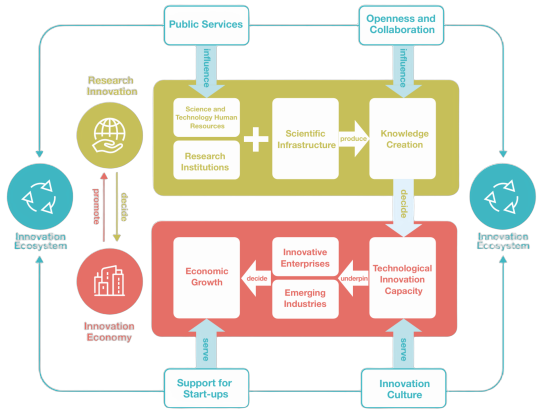
The International Science and Technology Innovation Center Index 2025 (GIHI2025) continues to uphold the fundamental principles of "science, objectivity, independence and impartiality", comprehensively assessing the development trends of international science and technology innovation cities from three dimensions: science centers, innovation highlands and innovation ecosystems, providing a reference basis for policymakers, entrepreneurs and practitioners.
国际科技创新中心评估的概念模型
Global hotspots of innovation
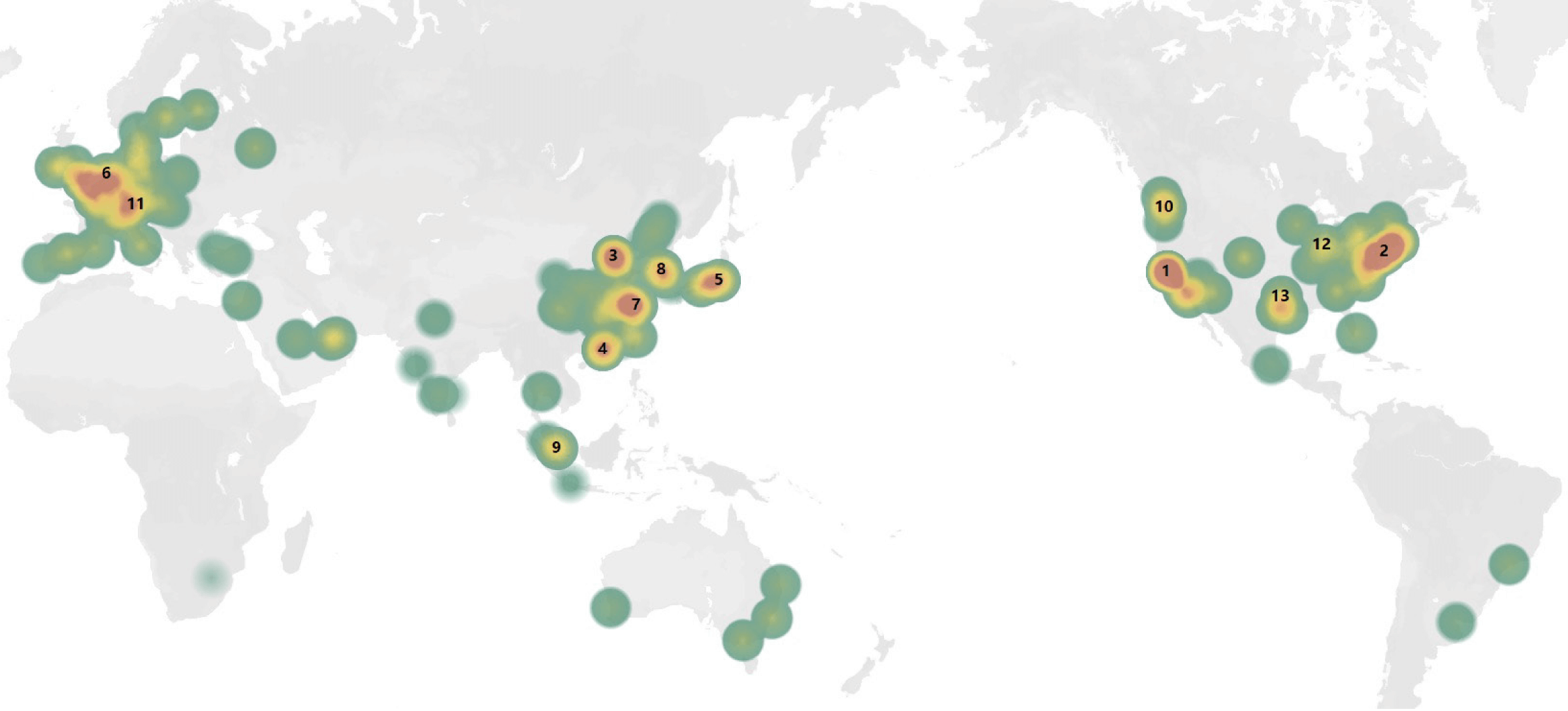
Note: The numbering is irrelevant to the rankings of the cities/metropolitan areas.
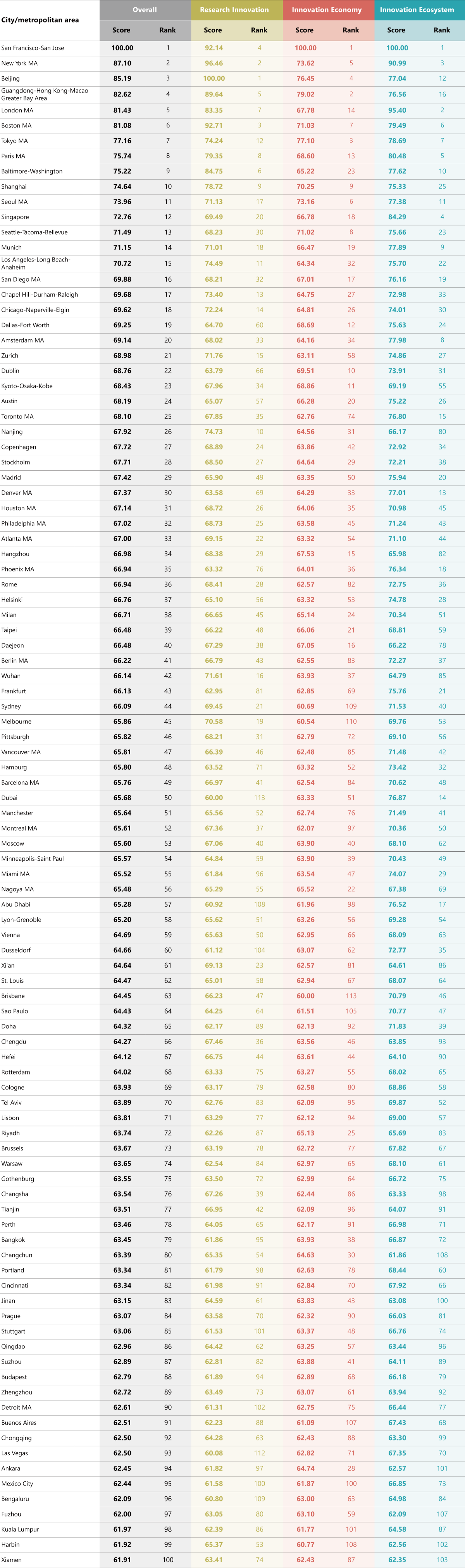
In terms of comprehensive innovation capabilities, SAN Francisco-San Jose has once again topped the International Science and Technology Innovation Center Index, achieving a sixth-consecutive championship, with its score far ahead of other cities (metropolitan areas). New York retained its runner-up position with 87.10 points, while Beijing ranked third with 85.19 points. The Guangdong-Hong Kong-Macao Greater Bay Area and London came in fourth and fifth respectively. The remaining top 20 cities (metropolitan areas) in terms of comprehensive scores are Boston, Tokyo, Paris, Balbaltimore - Washington, Shanghai, Seoul, Singapore, Seseattle - Tacoma-Bellevue, Munich, Los Angeles - Long Beach - Anaheim, San Diego, Church Hill - Durham - Lori, Chicago - Naperville - Elkin, Dallas-Fort Worth, and Ames Tedan. The overall layout of the top 20 cities (metropolitan areas) in the comprehensive ranking remains stable. San Francisco - SAN Jose, New York and Beijing have ranked among the top three for three consecutive years. With their outstanding innovation systems and accumulation, the positions of the major leading cities have remained relatively stable.
GIHI2025 continues to assess 12 micro-technology innovation centers (mini-Hubs). As the GIHI indicator system mainly focuses on scale indicators, the population of these cities is all less than one million and they are not suitable for inclusion in the overall ranking. Therefore, they are ranked separately. The urban population of micro-technology innovation centers (mini-Hubs) is small, but they have great innovative energy. In terms of regional distribution, except for Jerusalem which is located in Asia, the rest of the micro-technology innovation centers are all in Europe and America, belonging to the United States, Switzerland, Germany, the Netherlands, the United Kingdom and Norway respectively.
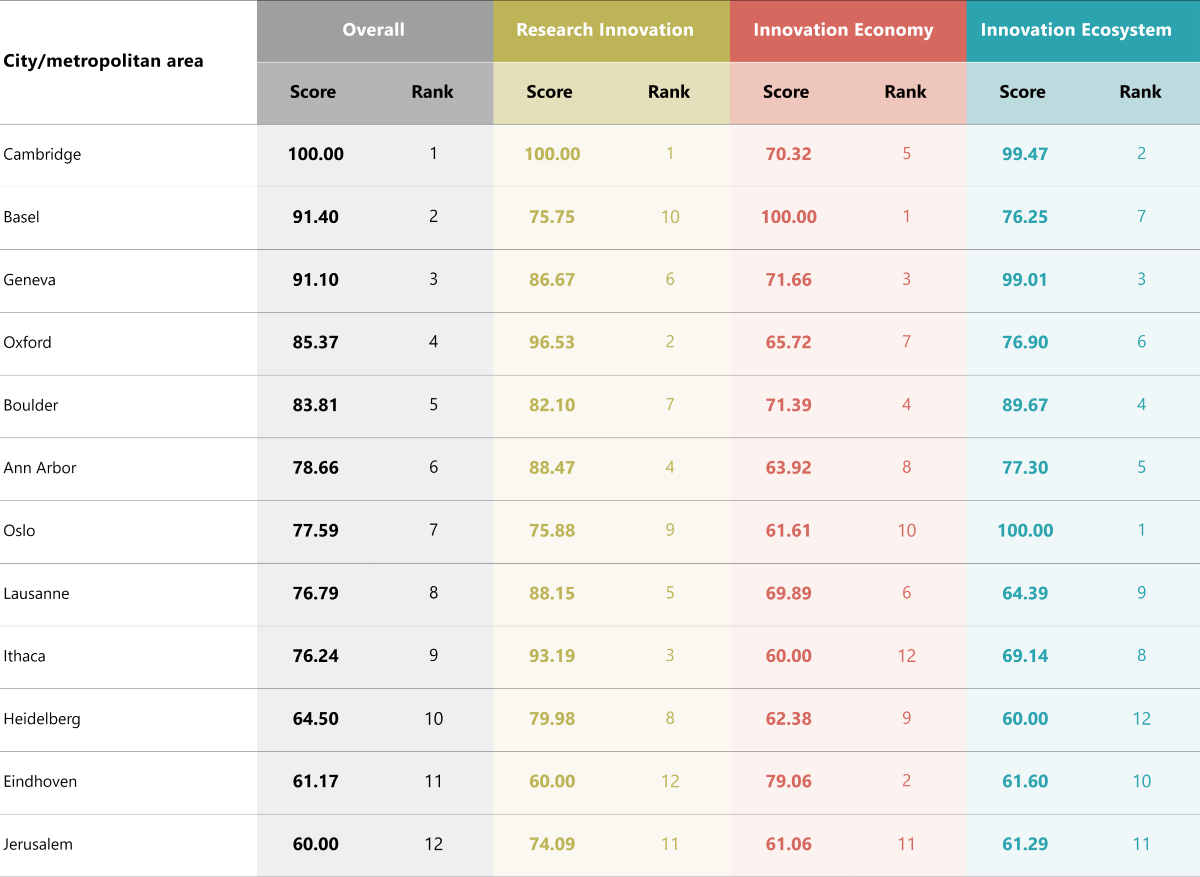
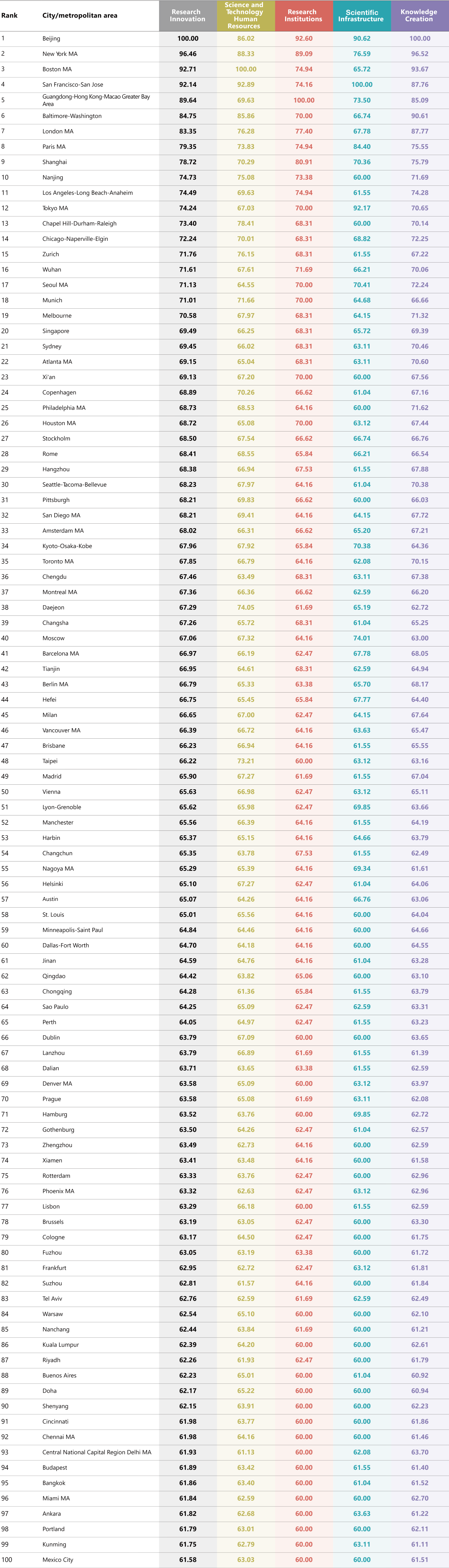
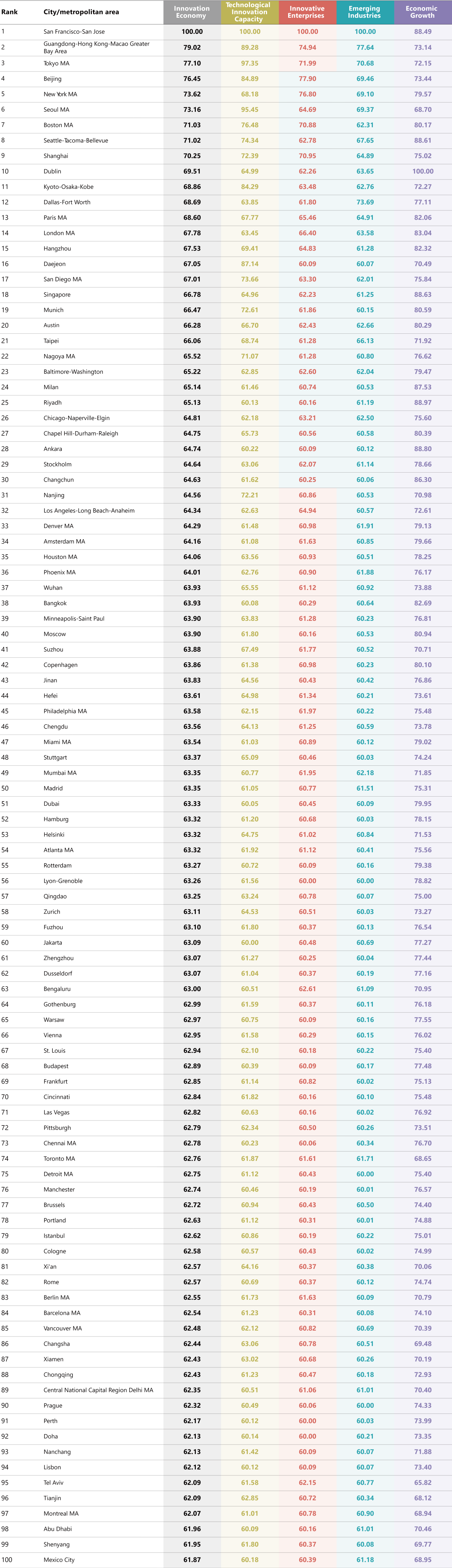

Overall, the competition among international science and technology innovation centers is becoming increasingly fierce. The global innovation landscape is accelerating towards multi-polarization. The booming AI industry has become a key engine driving innovation, and uncertainty is affecting the global innovation ecosystem. Relying on the highly integrated collaborative network of the megacity cluster, the leading cities in the global innovation hotspots highly gather innovation elements and simultaneously radiate and drive the development of the surrounding areas. The micro-science and technology innovation center continuously strengthens its professional fields through distinctive development paths and differentiated spatial functional forms. North American cities continue to lead in top-notch innovation capabilities and full-chain development. European cities maintain stability thanks to their profound cultural and institutional foundations, while Asian cities are catching up rapidly under the guidance of leading cities.
The world is seeking a new balance amid the superimposition of high interest rates, geopolitical tensions, climate risks and technological updates. As a key hub connecting knowledge, capital and industry, international science and technology innovation centers lead technological breakthroughs to become new drivers of growth, especially in generative artificial intelligence, high-end manufacturing, clean energy and biomedicine. Networked megagglomerations and cross-border corridors accelerate the flow of factors, but regional collaboration places higher demands on technical standards, data security and supply chain resilience. In the future, each center still needs to adhere to open collaboration, application-driven and institutional innovation, strengthen the supply of original innovation and the implementation of scenarios, and inject definite impetus into global recovery and long-term growth.
It should be pointed out that the global innovation network is in a dynamic evolution, and the indicator system still needs to be continuously optimized and improved. We sincerely invite global innovation assessors, practitioners and policy decision-makers to pay attention to this report and offer suggestions or opinions.
Download GIHI2025