Weekly Advanced Technologies〔48〕

Weekly Advanced Technologies〔48〕丨From "Laying Bricks from the Foundation Upwards" to "Pushing Against the Structure Above" : Chinese Scientists Pioneer a New Method for Crystal Synthesis丨Unraveling the Mystery of Lunar "Color" Changes through Lunar Glass
Crystals serve as pivotal materials in the realms of computers, communications, aerospace, and laser technology. The conventional approach to preparing large-sized crystals typically involves the sequential layering of atoms on the surface of small crystal particles, akin to "constructing a house" by laying bricks from the foundation upwards, layer by layer, culminating in the erection of a "house". A research team from Peking University has introduced an innovative crystal preparation technique, enabling materials to ascend like "the growing process of bamboo shoots" that "push against the structure above them". This method ensures swift growth and uniform alignment of each crystal layer, significantly enhancing the controllability of the crystal structure.
Based on earlier revelations about various types of glass substances in the lunar soil samples from Chang'e-5, the research team led by the Institute of Physics of the Chinese Academy of Sciences has conducted a detailed characterization and analysis of a series of glass samples in the lunar soil. The goal is to decipher the space weathering information recorded within these samples.
Based on the weekly diary of technology provided by the daily list of the NCSTI online service platform, we launch the column "Weekly Advanced Technologies" at the hotlist of sci-tech innovation. Today, let's check out No.48.
1. Science丨From "Laying Bricks from the Foundation Upwards" to "Pushing Against the Structure Above" : Chinese Scientists Pioneer a New Method for Crystal Synthesis
Crystals serve as pivotal materials in the realms of computers, communications, aerospace, and laser technology. The conventional approach to preparing large-sized crystals typically involves the sequential layering of atoms on the surface of small crystal particles, akin to "building a house" by laying bricks from the foundation upwards, layer by layer, culminating in the erection of a "house".
A research team from Peking University has introduced an innovative crystal preparation technique, enabling materials to ascend like "the growing process of bamboo shoots" that "push against the structure above". This method ensures swift growth and uniform alignment of each crystal layer, significantly enhancing the controllability of the crystal structure. This novel "long material" approach is anticipated to enhance the integration and computational power of chips, offering fresh materials for the next generation of electronic and photonic integrated circuits. The groundbreaking findings were published online on July 5 in the prestigious journal Science.
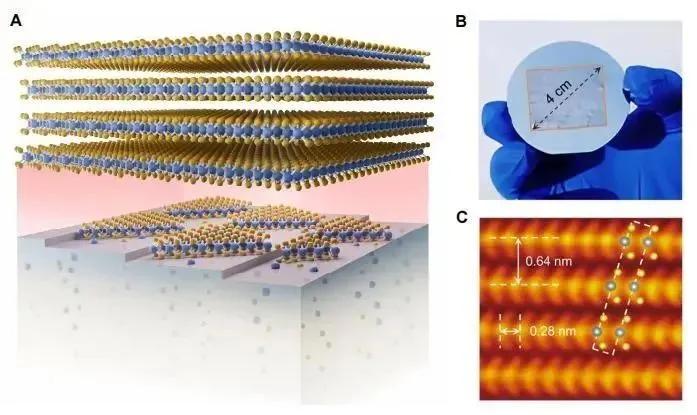
"Lattice Transfer - Interfacial Epitaxy" New method for preparing wafer-scale 2D crystals (photo by the interviewee)
Professor LIU Kaihui, Director of the Institute of Condensed Matter Physics and Materials Physics, School of Physics, Peking University, explained that the limitation of traditional crystal preparation methods lies in the strict selection required for the types of atoms and their arrangement patterns to stack and combine, forming a crystal. As the number of atoms continues to increase, the arrangement of atoms gradually becomes uncontrollable, with impurities and defects accumulating, affecting the purity and quality of the crystal. Therefore, there is an urgent need to develop new preparation methods to more precisely control the atomic arrangement and more finely regulate the crystal growth process.
In response to this challenge, Professor LIU Kaihui and his colleagues have innovatively proposed a novel crystal preparation paradigm known as "Lattice Transfer - Interfacial Epitaxy." This process begins with the arrangement of atoms on a "foundation", specifically a centimeter-sized metal surface, to form the initial layer of crystals. Subsequent atoms are then introduced to build upon this foundational layer, creating a new crystal layer atop the existing one. These newly added atoms penetrate the interface between the metal and the first crystal layer, and they grow against the established crystal layer above, continuously generating new crystal layers in a controlled manner.
Experiments have demonstrated that this unique method of "long material" enables the crystal layer architecture to reach a speed of 50 layers per minute, with a maximum of 15,000 layers. Moreover, the atomic arrangement in each layer is perfectly parallel and precisely controllable, effectively avoiding the accumulation of defects and enhancing structural controllability. Utilizing this new method, the team has successfully prepared seven types of high-quality two-dimensional crystals, including molybdenum disulfide, molybdenum selenide, and tungsten disulfide. These crystals have a single layer thickness of only 0.7 nanometers, whereas the currently used silicon materials typically range from 5 to 10 nanometers in thickness.

Electronic and photonic integrated circuits based on two-dimensional crystals (Photo by the interviewee)
"When these two-dimensional crystals are used as materials for transistors in integrated circuits, chip integration can be significantly improved. On a chip the size of a fingernail, the transistor density can be dramatically increased, thus realizing more powerful computing capabilities." In addition, these crystals can be used for infrared band frequency control, which is expected to promote the application of ultra-thin optical chips, said Professor LIU.
2. Nature Astronomy丨Unraveling the Mystery of Lunar "Color" Changes through Lunar Glass
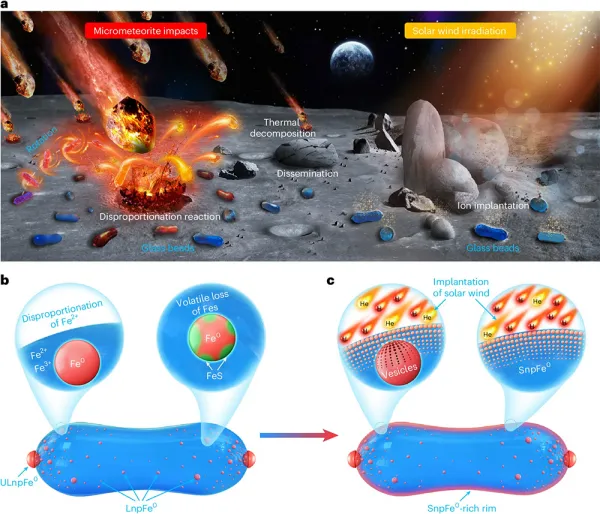
The effects of (micro)meteorite impacts and solar wind irradiation on the weathering of the lunar surface, as well as the formation and evolution of lunar glass beads and nano-sized metallic iron, are significant aspects of lunar geology and space science.
Based on earlier revelations about various types of glass substances in the lunar soil samples from Chang'e-5, the team led by Academician WANG Weihua from the Institute of Physics of the Chinese Academy of Sciences/National Center for Theoretical Sciences in Condensed Matter Physics, in collaboration with the team led by Academician YANG Mengfei from the China Academy of Space Technology and the team led by Academician ZOU Zhigang from Nanjing University, have conducted a detailed characterization and analysis of a series of glass samples in the lunar soil. Their goal is to decipher the space weathering information recorded within these samples.
The study found that a single lunar glass bead can simultaneously store nano-sized metallic iron particles of varying sizes, distributions, and microscopic characteristics. By leveraging the clear impact origin and rotational features of the glass bead, the researchers identified large and small-sized nano-iron particles produced before and after the glass bead's formation and solidification.
Furthermore, by integrating knowledge from astronomy, space science, and other disciplines, the study revealed that large and small-sized nano-iron particles with distinct spectral modification effects have independent formation mechanisms, corresponding respectively to (micro)meteorite impacts and solar wind irradiation on the lunar surface.
This discovery highlights the significant and distinct roles of (micro)meteorite impacts and solar wind irradiation in the process of space weathering. It deepens our understanding of the interaction mechanisms between the space environment and lunar surface materials, providing insights for future exploration and prediction of lunar magnetic anomaly zones, lunar shadow regions, and the color variation patterns of asteroids and other celestial bodies under different space environments.
Comprehensive research on the nano-sized metallic iron produced by space weathering in the lunar soil samples from Chang'e-5 has challenged the classical notion that nanoscale iron formation is controlled by impact deposition or a single mechanism. The study emphasizes the multiple origins of nano-iron particles and confirms that the formation of large and small-sized nano-iron is respectively dominated by impact and irradiation processes. It clarifies the crucial roles of (micro)meteorites and solar wind in space weathering and the color changes of celestial bodies. These findings align with a wealth of remote sensing spectral data collected in recent years, providing guidance for predicting the optical properties of celestial bodies or regions that have experienced different space environments.
3. Nature Astronomy丨"Time Animation", the New Method Unveils the Shape of the Milky Way's Dark Matter Halo
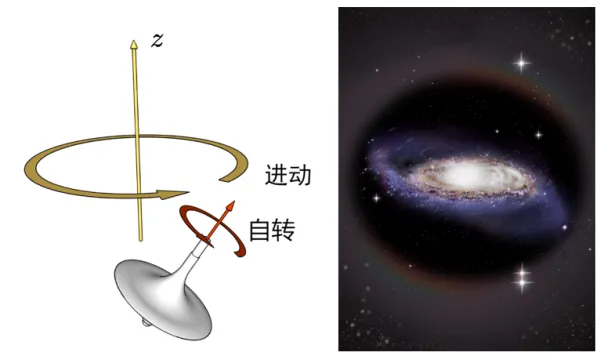
Left image: A spinning top undergoes precession under the torque of gravity; Right image: Analogously, the warped silver disk "dances (precesses)" under the torque of the dark matter halo (an artistic rendering by Shanghai Jiao Tong University)
In the immediate cosmos, the majority of disk galaxies display a chip-like curvature in their outer regions, a phenomenon known as warps. The Milky Way, exemplifying a typical disk galaxy, also exhibits these warp characteristics. It is widely held that the genesis of these warps stems from the deviation of the outer disk's rotational plane from the plane of symmetry of the encompassing dark matter halo. This tilted, rotating disk behaves akin to a spinning gyroscope, subject to the gravitational moment exerted by the dark matter halo, thereby inducing the warp progression.
Nevertheless, the speed at which this warping progresses remains a subject of contention, particularly regarding the measurement of both direction and rate. This uncertainty arises from the reliance on previous measurements that employed indirect kinematic methods, utilizing tracer objects whose accuracy and precision are susceptible to dynamical perturbations or heating effects.
Recently, a collaborative effort involving the University of Chinese Academy of Sciences, the National Astronomical Observatory of the Chinese Academy of Sciences (NAOC), Peking University, and Shanghai Jiao Tong University has introduced a novel "time animation" method. This method leverages data from the Guo Shoujing Telescope, a significant national scientific and technological infrastructure managed by NAOC, as well as information from the European Space Agency's Gaia satellite.
By utilizing samples of variable stars of varying ages, this innovative approach enables a direct measurement of the direction and rate of warping in the galactic disk. The study, based on these direct measurements, reveals that the current dark matter halo of the Milky Way is a flat ellipsoid that closely resembles a sphere. This finding serves as a crucial anchor point in the exploration of the Galactic dark matter halo's evolution.
4. Nature Climate Change丨Behind the Worsening Salinity Contrast: the Unexpected Importance of Wind- and Heat-Driven Processes in Oceanic Evolution
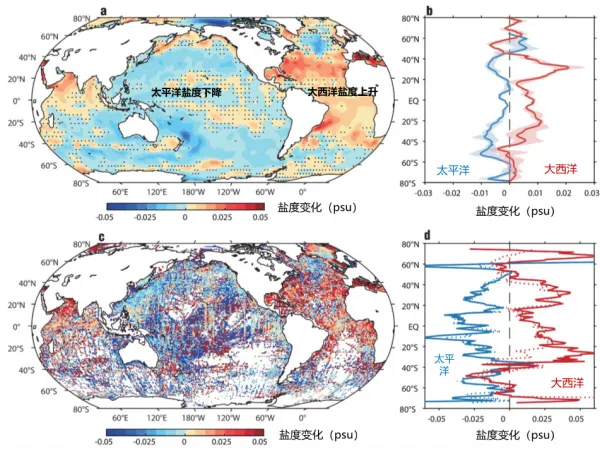
Changes in mean ocean salinity (in psu) from 0-2000 m since 1965 based on observational data
Ocean salinity, as one of the fundamental properties of seawater, plays a pivotal role in shaping ocean stratification and circulation patterns. Globally, the pronounced contrast in salinity between the Atlantic Ocean's high levels and the Pacific Ocean's relatively low levels significantly influences the distinct characteristics of the water masses, circulation structures, climate states, and biogeochemical cycles in these two major oceans.
This salinity dichotomy may also dictate their differential responses and feedback mechanisms to climate change. Against the backdrop of global warming, ocean salinity is undergoing transformative alterations. Yet, the extent to which the salinity disparities between the Atlantic and Pacific are intensifying or diminishing remains uncertain. Additionally, it is unclear whether contemporary climate models, such as those in the CMIP6 framework, can accurately simulate these evolving salinity dynamics.
Recently, WANG Fan's team at the Institute of Oceanography of the Chinese Academy of Sciences, in conjunction with the Institute of Atmospheric Physics (IAP), has analyzed the oceanic 0-2000-meter observational data and revealed a strengthening trend of the Atlantic–Pacific salinity contrast (APSC) over the past half century (since 1965), i.e., an overall increase in Atlantic salinity and a general decrease in Pacific salinity.
This trend shows a clear meridional structure, which is more prominent in the subtropics of both the northern and southern hemispheres. In particular, the APSC has strengthened by 5.9 ± 0.6% between 20° and 40° N. The strengthening of the APSC has wide-ranging impacts, in particular exacerbating the trends of sea-level rise, ocean stratification, hypoxia and acidification of subsurface waters in the Pacific Ocean.
This study quantitatively reveals the strengthening trend of the APSC and its spatial structure since the middle of the 20th century, elucidates the important roles of the wind-generated ocean circulation variability and the migration of water mass sources on salinity changes, and explores the general bias of the current climate model in the simulation of salinity changes and its causes. The results are of reference value for improving climate models and enhancing climate prediction.
5. Nature Communications丨From Cells to Signals: stKeep's Precision Mapping of Tumor Microenvironment Heterogeneity
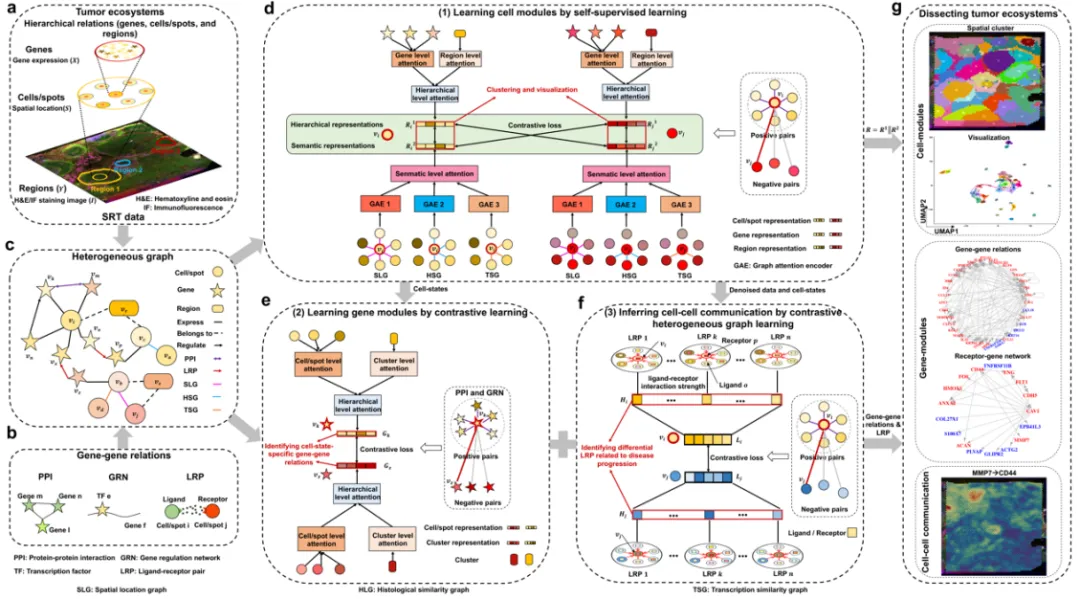
The framework for the stKeep algorithm
Cancer portrays a complex tumor ecosystem, wherein tumor cells interact with their microenvironment, comprising immune and stromal cells, to navigate survival amidst harsh conditions like hypoxia. Previously, Luo Nan Chen and Chun Man Zuo introduced stMVC, a tool designed to dissect the intratumoral heterogeneity. The forthcoming challenge lies in harnessing spatial transcriptomic data to elucidate the intricate molecular interactions within and the cellular communication networks that govern tumor heterogeneity.
Recently, the research team also proposed a deep learning method (stKeep) for resolving the heterogeneity of tumor microenvironment from spatial histology data - based on a heterogeneous graph model integrating multimodal data of spatial transcription (gene expression, physical location, pathology information, tumor region) and molecular network information (protein-interaction network, gene-regulation networks and ligand-receptor interaction networks) to identify heterogeneous cellular states of the tumor microenvironment, specific gene-gene interaction networks, and cellular communication patterns associated with disease progression.
In the application of triple-negative breast cancer, stKeep was able to detect more cellular states within the tumor region compared to other methods.
Moreover, through the integration of paired scRNA-seq data, stKeep uncovered a subset of myoepithelial cells that had been erroneously classified as normal in prior investigations, yet were indeed tumor-associated. The tool hypothesized that these cells serve as pivotal transcription factors, ligands, and receptors, playing a critical role in disease progression. Applied to colon cancer liver metastasis, stKeep successfully pinpointed essential cell populations and cellular communication pathways that facilitate the metastatic spread of colon cancer cells into the healthy liver tissue.
These biological insights have been further corroborated through independent samples and clinical data. By integrating multi-modal and molecular network data, stKeep constructs cellular modules, gene modules, and cellular communication modules, thereby dissecting the heterogeneity of the tumor ecosystem. Additionally, stKeep will provide support for the application of spatial transcriptomic data in clinical prognosis and immunotherapy.
Columnist: Li Xiaoxiao
Translator: Liu Kaiyuan