Weekly Advanced Technologies〔93〕

Weekly Advanced Technologies〔93〕丨High-Precision Thickness Characterization of Nanofilms via Vertical Cross-Sectional Preparation; Chloride Homogenization Enabled High-Efficiency and Stable Perovskite Solar Cells
Precise characterization of Mo/Si multilayer film thickness is critical for optical performance. Addressing artifacts in TEM measurements, a novel method has significantly improved measurement accuracy by optimizing sample orientation. Separately, non-uniform vertical distribution of chloride ions in perovskite thin films leads to defects and carrier loss. The research team at the Chinese Academy of Sciences demonstrated that controlled regulation of chloride distribution uniformity simultaneously enhances device efficiency and stability.
Based on the weekly diary of technology provided by the daily list of the NCSTI online service platform, we launch the column "Weekly Advanced Technologies" at the hotlist of sci-tech innovation. Today, let's check out No.93.
1. Acta Optica Sinica丨High-Precision Thickness Characterization of Nanofilms via Vertical Cross-Sectional Preparation
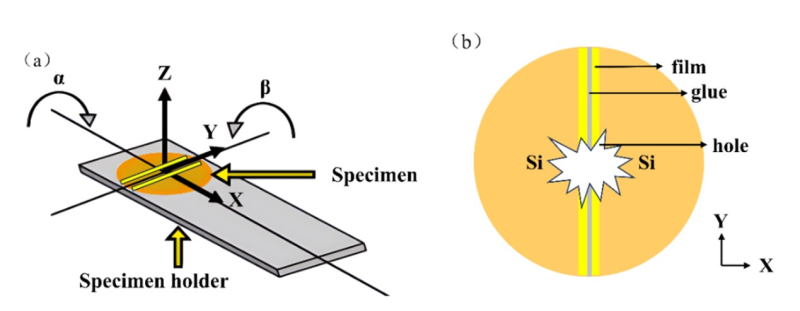
Schematic diagram of TEM cross-section sample tilting
Mo/Si multilayer films with a period thickness of approximately 7.0 nm are widely used to enhance the reflectivity of optical devices. However, sub-nanometer-scale thickness variations can induce shifts in reflectance spectrum peak wavelengths, making high-precision characterization crucial for process optimization. Transmission electron microscopy (TEM) is a standard technique, but when the sample cross-section isn't perpendicular to the electron beam—such as when using Si substrates with inappropriate crystal orientations—two-dimensional projection artifacts may occur, leading to thickness measurement errors.
The research team at the Shanghai Institute of Optics and Fine Mechanics (SIOM), Chinese Academy of Sciences has made progress in this field by developing a novel approach to improve TEM characterization accuracy. Using Mo/Si multilayers deposited on Si[100] substrates as an example, the team systematically investigated imaging characteristics at different tilt angles: α-axis tilting maintained consistent thickness measurements but increased interface roughness visibility, while β-axis tilting caused severe artifacts from cross-section inclination, obscuring Mo/Si layer boundaries. The team derived a thickness correction formula for β-axis tilting and proposed an optimized sample preparation protocol: cutting samples along the Si wafer's [1-10] direction and observing along the [110] zone axis ensures both substrate and multilayer cross-sections remain perpendicular to the electron beam. This method enables artifact-free imaging in thinner sample regions, significantly improving thickness measurement precision.
This advancement not only facilitates deeper understanding of the microstructure-property relationship in optical coatings but also provides reliable characterization methodology for thin-film process refinement.
2. Science丨Homogenization Enabled High-Efficiency and Stable Perovskite Solar Cells
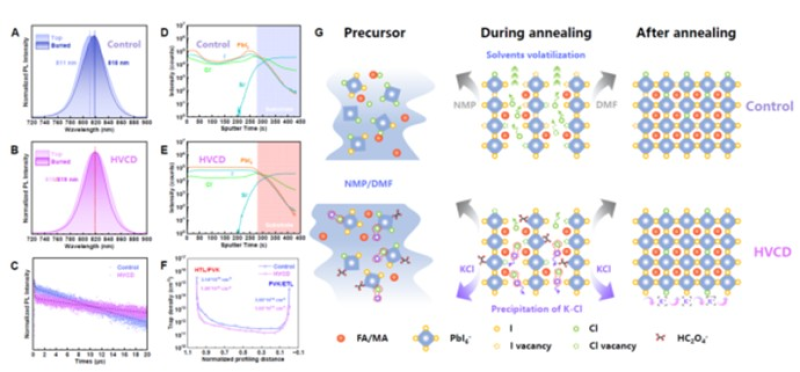
Scientists develop perovskite solar cell with over 27% photoelectric conversion efficiency
Perovskite solar cells have seen their photoelectric conversion efficiency leap from 3.8% to over 26% in the past decade, yet still fall short of the theoretical limit. Fabricating high-quality perovskite films remains key to breaking this bottleneck. Methylammonium chloride (MACl) is commonly used as an auxiliary additive as it reduces nucleation barriers and promotes crystal growth. However, a team led by You Jingbi at the Institute of Semiconductors, Chinese Academy of Sciences discovered that chlorine ions introduced by MACl rapidly migrate to the upper surface during crystallization, causing uneven vertical chlorine distribution. This induces surface defects and interfacial electron barriers, exacerbating carrier recombination and hindering transport, thereby limiting efficiency and stability improvements.
To address this, the team proposed a "homogeneous vertical chlorine distribution" (HVCD) strategy: introducing alkali metal oxalates during perovskite film formation. The potassium ions dissociated from these oxalates strongly interact with chlorine ions, effectively suppressing disordered chlorine migration and achieving uniform chlorine distribution across the entire film thickness. The resulting perovskite film exhibits a carrier lifetime of 20 μs and an ultra-low interface defect density of 10¹³ cm⁻³, significantly mitigating recombination losses caused by chlorine accumulation while eliminating interfacial barriers. Using this film, the team developed a perovskite solar cell with a certified photoelectric conversion efficiency of 27.2% (verified by multiple authoritative institutions). The device maintained 86.3% of its initial efficiency after 1,529 hours of maximum power point operation under standard illumination, and retained 82.8% efficiency after 1,000 hours of light-thermal coupled aging at 85°C.
This achievement represents a breakthrough in simultaneously enhancing efficiency and stability, providing critical technical support for perovskite solar cell industrialization.
3. Nature Biotechnology丨Novel Live-Cell DNA Imaging Technology Unveils Chromatin Dynamic Regulation

Figure caption: CRISPR PRO-LiveFISH design strategy and applications
Three-dimensional genome interactions and epigenetic modifications are crucial for gene expression regulation, with their dynamic changes closely linked to development and cancer. However, existing CRISPR-Cas live-cell imaging methods remain limited in sensitivity and system complexity when applied to non-repetitive sequence labeling, multi-locus synchronous observation, and primary cell studies.
The Institute of Biophysics, Chinese Academy of Sciences in collaboration with Tsinghua University has integrated CRISPR with expanded genetic alphabet technology to develop a novel live-cell DNA imaging system—CRISPR PRO-LiveFISH.
This technology introduces orthogonal unnatural base pairs and achieves site-specific fluorescent labeling of sgRNA through rational design of Cas9/sgRNA structures, significantly improving sensitivity. By combining in vitro transcription with post-transcriptional modification strategies, researchers constructed a high-throughput, site-specific sgRNA probe library. Using just 10 sgRNAs, the system efficiently labels non-repetitive DNA sequences, enabling multicolor dynamic imaging of up to 6 genetic loci in primary cells with minimal endogenous gene interference.
Using PRO-LiveFISH, the research team has discovered that chromatin locus movement strongly correlates with its epigenetic modification state: loci with high histone acetylation show restricted mobility, while deacetylated loci exhibit enhanced movement. Simultaneously, enhancers maintain persistent spatial proximity with their target genes during dynamic processes, demonstrating high spatiotemporal stability of interactions. Further studies reveal that transcriptional coactivator BRD4 plays an essential role in maintaining 3D interactions between super-enhancers and target genes, with its inhibition leading to interaction dissociation.
The technology has provided a powerful tool for studying 3D genome dynamics in living cells and has deepened our understanding of epigenetic and chromatin spatial regulation mechanisms. The collaboration between Chinese Academy of Sciences and Tsinghua University has established a new paradigm for real-time observation of genome architecture with single-cell resolution.