Weekly Advanced Technologies〔94〕

Weekly Advanced Technologies〔94〕丨Single Atom Realization of the Recoiling Slit Thought Experiment; Precision Regulation of Thermotolerance Genes to Engineer Heat-Resistant Rice
The team from the University of Science and Technology of China has experimentally realized Einstein's 1927 "recoiling slit" thought experiment for the first time, verifying the quantum complementarity principle and revealing the continuous transition from quantum to classical world. Meanwhile, the team from the Institute of Zoology, Chinese Academy of Sciences has uncovered the core mechanism of prostate aging in primates by identifying the GRHL2-CDK19-p53-p21 signaling axis, and successfully developed targeted gene therapy strategies.
Based on the weekly diary of technology provided by the daily list of the NCSTI online service platform, we launch the column "Weekly Advanced Technologies" at the hotlist of sci-tech innovation. Today, let's check out No.94.
1. Physical Review Letters丨Single Atom Realization of the Recoiling Slit Thought Experiment
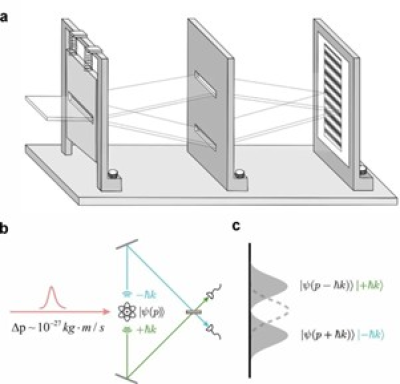
Quantum Interferometer with Single Photon and Single Atom Realizes Einstein's Thought Experiment
The research team from the University of Science and Technology of China (USTC) employed a single rubidium atom confined in an optical tweezer as a "movable slit," achieving for the first time an experimental realization that faithfully reproduces the "recoiling slit" quantum interference thought experiment proposed during the 1927 debate between Einstein and Bohr.
Through Raman sideband cooling techniques, the atom was cooled to its three-dimensional motional ground state, reducing its momentum uncertainty to a level comparable to the single-photon recoil momentum. This satisfied the quantum limit requirements for detecting weak recoil signals. The experiment precisely controlled the atom's momentum uncertainty by adjusting the depth of the optical tweezer potential well and employed closed cycling transitions to eliminate internal-state interference. To ensure interference stability, the team developed an active feedback phase-locking technique, confining path fluctuations to the nanometer scale.
The results demonstrated that as the well depth increased, the momentum wavefunction of the atomic ground state broadened, weakening the entanglement between the photon recoil and the atom, thereby enhancing the photon interference contrast. Simultaneously, classical noise (e.g., atomic heating) reduced the contrast; after calibration, the experimental data closely matched the ideal quantum limit. Furthermore, by tuning the average phonon number of the atom, the team observed a decrease in interference contrast with increasing phonon count, clearly illustrating the system's transition from quantum to classical behavior.
This work has not only realized this century-old thought experiment at the quantum limit for the first time but has also laid a foundation for high-precision single-atom manipulation, single-photon-atom entanglement, and future quantum technologies involving neutral atoms. The breakthrough has opened new possibilities for testing fundamental quantum principles and developing advanced quantum control techniques.
2. Nature Aging丨Gene Therapy Alleviates Aging-Associated Prostate Dysfunction
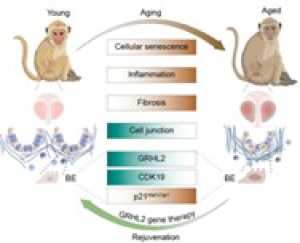
Mechanisms and Interventions of Prostate Aging
A research team from the Institute of Zoology, Chinese Academy of Sciences, has systematically elucidated the key cellular and molecular mechanisms underlying prostate aging in primates.
By comparing different anatomical regions of the prostate in young and aged cynomolgus monkeys, combined with histological and high-resolution single-nucleus transcriptomic analyses, the team identified three major pathological hallmarks: epithelial cell senescence, chronic inflammation, and stromal fibrosis. These findings suggest that prostate aging is a systemic degenerative process.
Further investigation revealed that the transcription factor GRHL2 is significantly downregulated in basal epithelial cells with age—a phenomenon highly conserved across humans, non-human primates, and mice. Mechanistically, GRHL2 inactivation reduces the expression of its target gene CDK19, thereby relieving inhibition on p53 and activating the p53-p21 pathway, which drives cellular senescence. This establishes the GRHL2-CDK19-p53-p21 signaling axis as a central regulator of prostate aging.
Leveraging these discoveries, the team developed a GRHL2-targeted gene therapy strategy. Local injection of a lentiviral vector encoding GRHL2 into the prostate of aged mice successfully restored GRHL2 and CDK19 expression, suppressed epithelial cell senescence, reversed molecular aging markers, and significantly improved lower urinary tract dysfunction.
This study has not only provided the first systematic dissection of the regulatory network governing prostate aging in primates but also achieved a translational milestone, bridging mechanistic insights to therapeutic intervention. The findings offer novel targets and a potential treatment strategy for age-related prostate disorders.
3. Cell丨Precision Regulation of Thermotolerance Genes to Engineer Heat-Resistant Rice
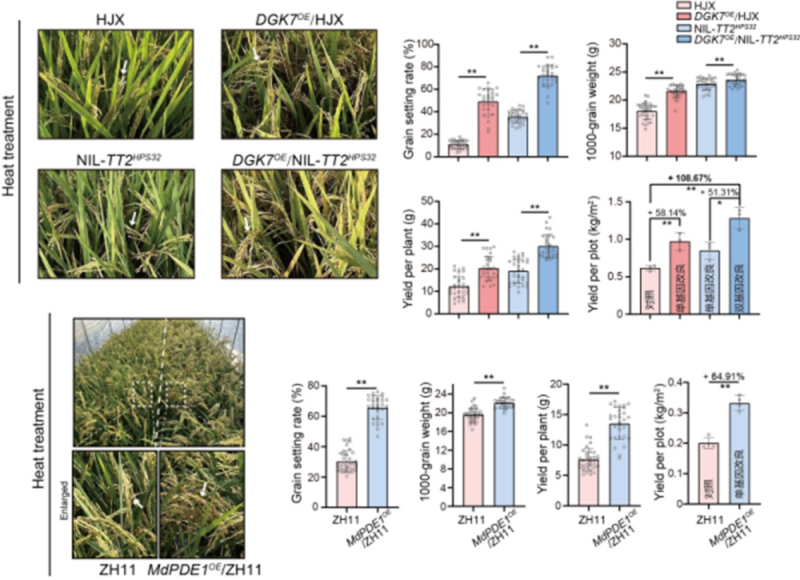
Precision-engineered Gradient Thermotolerant Rice Achieves Stable Yield Under High Temperature
A research team led by Academician Lin Hongxuan from the CAS Center for Excellence in Molecular Plant Sciences, in collaboration with Shanghai Jiao Tong University and other institutions, has systematically deciphered the complete signaling pathway for rice's perception and response to high-temperature stress.
The study revealed that high temperature initially triggers cell membrane lipid remodeling, which activates diacylglycerol kinase DGK7 to catalyze the production of second messenger phosphatidic acid (PA), achieving the first conversion from physical signal to lipid signal. The G protein subunit TT2/RGB1 negatively regulates this process by inhibiting phosphorylation at serine 477 of DGK7. Subsequently, the bifunctional protein MdPDE1 senses PA concentration changes through its PA-binding domain. Upon activation, MdPDE1 translocates to the nucleus to hydrolyze cyclic adenosine monophosphate (cAMP), reducing nuclear cAMP levels and completing the secondary conversion from lipid signal to cAMP signal. The cAMP decrease triggers transcriptional reprogramming that upregulates heat-resistant genes such as small heat shock proteins and reactive oxygen species scavenging enzymes, establishing an effective heat-response mechanism.
Based on this pathway, the team achieved targeted rice improvement: single-gene (DGK7 or MdPDE1) edited lines showed 50%-60% yield increase under simulated high temperature; TT2 and DGK7 double-gene modified lines nearly doubled their yield with improved grain quality and no yield penalty under normal conditions.
The research has not only elucidated the "membrane-to-nucleus" tandem mechanism of thermal signal decoding, but also provided customizable gene modules and theoretical support for precision breeding of heat-resistant staple crops like rice.