Weekly Advanced Technologies〔98〕

Weekly Advanced Technologies〔98〕丨Breakthrough Study Reveals Trajectory and Impact Potential of Interstellar Comet 3I/ATLAS; Scalable Manufacturing of Perovskite PVs Enabled by Innovative Pre-Seeding Strategy
The third interstellar visitor to the Solar System, Comet 3I/ATLAS, has entered the inner Solar System in retrograde motion. An international team led by the Shanghai Astronomical Observatory of the Chinese Academy of Sciences has utilized high-precision simulations to reveal its collision risks with Solar System celestial bodies and its scientific research value.
Perovskite solar cells represent a critical direction for next-generation photovoltaic technology. Teams including the Qingdao Institute of Bioenergy and Bioprocess Technology of the Chinese Academy of Sciences have overcome interfacial bottlenecks, developing a highly efficient and scalable preparation strategy.
Based on the weekly diary of technology provided by the daily list of the NCSTI online service platform, we launch the column "Weekly Advanced Technologies" at the hotlist of sci-tech innovation. Today, let's check out No.98.
1. The Astronomical Journal丨Breakthrough Study Reveals Trajectory and Impact Potential of Interstellar Comet 3I/ATLAS
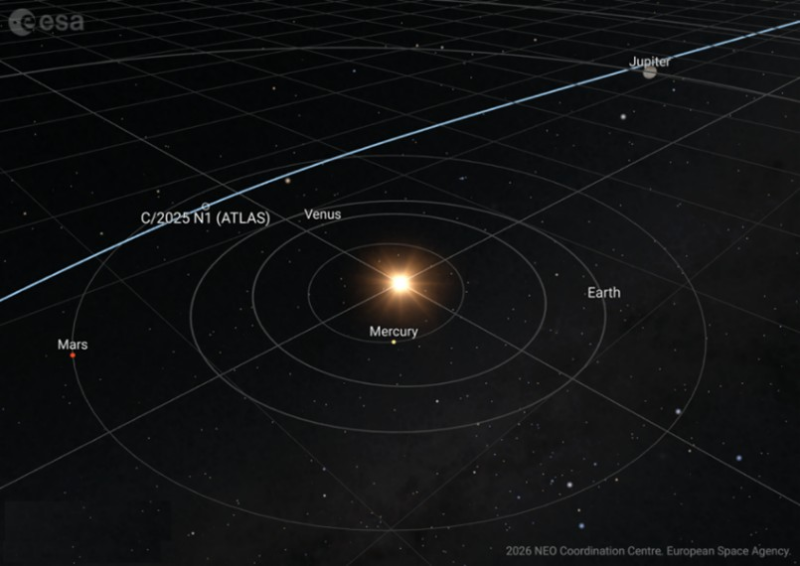
Schematic Diagram of Comet C/2019 ATLAS (3I/ATLAS) Trajectory Through the Inner Solar System. (Source: ESA NEOCC)
Following the interstellar objects 'Oumuamua in 2017 and 2I/Borisov in 2019, the Solar System has welcomed its third confirmed interstellar visitor—Comet 3I/ATLAS (designated C/2025 N1). Unlike its predecessors, which passed safely through the outer reaches of the Solar System, this comet follows a nearly retrograde orbit with an inclination of approximately 175° and will approach as close as 1.36 astronomical units (AU) from the Sun. Its trajectory will take it against the flow through the densely populated inner Solar System.
To assess potential collision risks with Solar System bodies, an international research team led by the Shanghai Astronomical Observatory of the Chinese Academy of Sciences conducted a detailed study focusing on the comet's critical passage through the inner Solar System from August 2025 to April 2026. Using N-body numerical simulations, the team accounted for gravitational influences from the Sun, the eight major planets, and numerous asteroids. They screened orbital data from over 38,000 near-Earth asteroids and 1.4 million main-belt asteroids to evaluate close-encounter probabilities.
The analysis revealed that during this period, 31 near-Earth asteroids and 736 main-belt asteroids will approach within 0.03 AU (approximately 4.5 million kilometers, about 10 times the Earth-Moon distance) of Comet 3I/ATLAS. Among these, the highest direct impact probability was identified with asteroid 2020 BG107, estimated at approximately 0.025%. Additionally, there is a 2.7% probability that asteroids may pass through the comet's coma—the envelope of gas and dust surrounding its nucleus.
Beyond assessing collision risks, this study provides new insights into Solar System dynamics and offers a predictive framework applicable to future interstellar object observations. The methodology developed here can be extended to evaluate trajectories and risks of similar celestial bodies, enhancing our understanding of both interstellar visitors and Solar System evolution.
2. Nature Synthesis丨Scalable Manufacturing of Perovskite PVs Enabled by Innovative Pre-Seeding Strategy
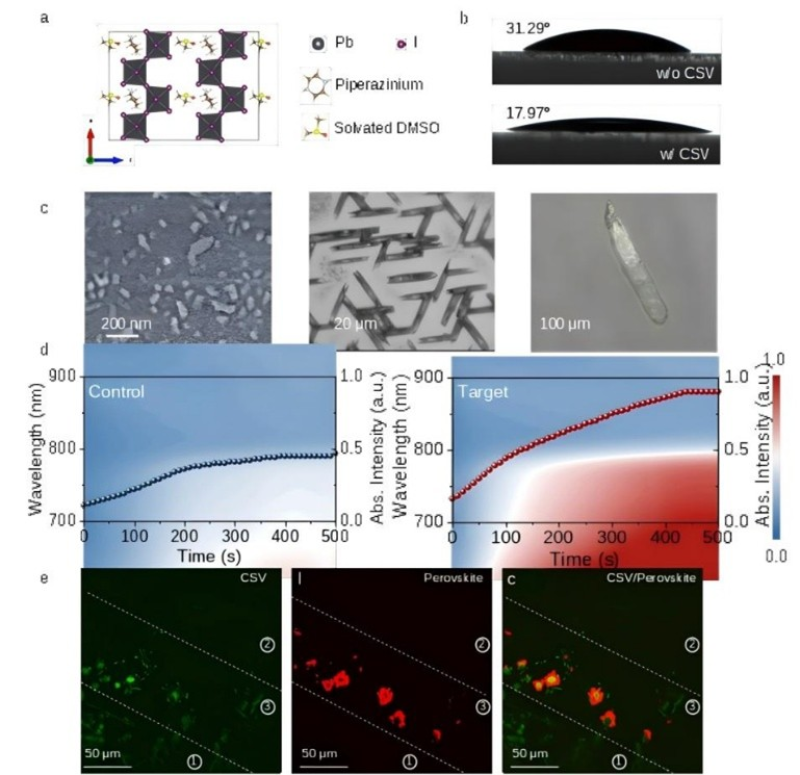
Mechanism of Action of crystal solvates (CSVs) Pre-seeds
Perovskite solar cells (PSCs) are considered a cornerstone of next-generation photovoltaics due to their high efficiency and solution-processability. In recent years, inverted-structure PSCs based on self-assembled monolayers have achieved significant efficiency breakthroughs. However, uncontrolled microstructure and electronic defects at the bottom interface of the perovskite layer remain a critical bottleneck limiting both device performance and long-term stability.
Addressing this challenge, a research team led by the Qingdao Institute of Bioenergy and Bioprocess Technology of the Chinese Academy of Sciences, in collaboration with partners, has proposed an innovative Pre-Seeding strategy of crystal solvates (CSVs) for interface engineering. This method involves pre-depositing specially designed low-dimensional halide crystal-solvate complexes as "seeds" on the substrate, enabling comprehensive control over the bottom perovskite film's crystallization process, microstructure, and interfacial electronic properties.
The CSV nanocrystals enhance substrate wettability, allowing uniform spreading of the perovskite precursor solution while serving as nucleation sites to accelerate perovskite crystallization. During thermal annealing, the solvent molecules locked within the CSV are released in a controlled manner, creating a mild growth environment. This process effectively eliminates interfacial voids, smoothens grain boundaries, and yields a dense, high-quality bottom crystal structure with reduced defect density.
By integrating this method with scalable blade-coating techniques, the team successfully fabricated a perovskite photovoltaic mini-module with an active area of 49.91 cm², achieving a power conversion efficiency (PCE) of 23.15%. Remarkably, the efficiency loss upon scaling was less than 3%, demonstrating excellent process scalability and film uniformity.
This work not only provides a scalable and efficient solution for interface regulation in inverted perovskite solar cells but also establishes the pre-seeding concept as a versatile and expandable materials platform for future optoelectronic applications.
3. Nature Sensors丨AI-Powered Insights Unlock Chemical Evolution Secrets of the Moon's Far Side
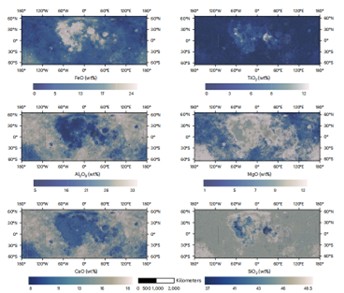
Mapping of Major Oxide Content Distribution on the Lunar Surface (New Generation)
Analyzing the global distribution of chemical elements on the lunar surface is a fundamental approach to deciphering the Moon's internal structure, geological evolution, and the formation and development of the Earth-Moon system. Previously, remote sensing studies of lunar elemental abundance could only be calibrated using sampling data from the near side, leaving nearly half of the lunar surface—the far side—in a long-term "observational blind spot." Existing inversion models showed significant deviations over the far side's complex terrain, leaving many key scientific questions without precise quantitative data support.
A research team led by the Shanghai Institute of Technical Physics of the Chinese Academy of Sciences, among other institutions, has now broken through this barrier. Utilizing the world's first ground-truth sample data from the lunar far side, obtained by the Chang'e-6 mission, and combining it with high-resolution spectral imaging data from lunar orbit, the team has established an AI-powered inversion framework based on a Residual Convolutional Neural Network. This breakthrough has enabled the creation of the first high-precision global map of major oxide content on the Moon, integrated with in-situ far-side validation data.
This research overcomes the long-standing challenge of lacking ground-truth constraints for chemical composition inversion on the lunar far side. It significantly enhances the accuracy of element inversion on a global scale and reconstructs the global distribution of six major oxide elements. The study provides the first quantitative confirmation that the exposure ratio of magnesium-rich rocks in the far-side highlands is significantly higher than on the near side. It also clarifies the characteristics of deep-seated material exposure in the South Pole–Aitken Basin, filling a critical data gap in lunar far-side geological research.
The resulting high-precision global oxide distribution map provides robust scientific support for subsequent lunar exploration projects and resource prospecting, marking a major advancement in our understanding of lunar composition and evolution.