Weekly Advanced Technologies〔99〕

Weekly Advanced Technologies〔99〕丨When Asteroids Wear Disguise: Decoding Their True Composition; High-Efficiency Solar Hydrogen Production Enabled by Novel Artificial Photosynthetic System
Asteroids hold the primordial secrets of the Solar System's formation. A key breakthrough has been made by an international team led by the Shanghai Astronomical Observatory of the Chinese Academy of Sciences, successfully deciphering the spectral puzzle of S-type asteroids. Separately, inspired by the super-efficient energy transfer of natural photosynthetic chlorosomes, a team from the Shanghai Institute of Organic Chemistry of the Chinese Academy of Sciences has developed a novel biomimetic photosynthetic assembly, enabling highly efficient and stable photocatalytic hydrogen production.
Based on the weekly diary of technology provided by the daily list of the NCSTI online service platform, we launch the column "Weekly Advanced Technologies" at the hotlist of sci-tech innovation. Today, let's check out No.99.
1. Astrophysical Journal Supplement Series丨When Asteroids Wear Disguise: Decoding Their True Composition
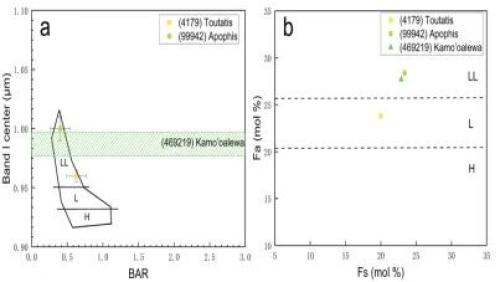
Mineralogical Analysis of Multiple Asteroid Mission Targets Based on Spectroscopic Observational Data
Asteroids preserve primordial information from the initial formation of the Solar System 4.6 billion years ago. Astronomers classify asteroids into three major types—S, C, and X—based on their spectral characteristics. Among them, S-type asteroids are the most common in the near-Earth population, and their composition is similar to ordinary chondrites found on Earth. The scientific community typically infers their mineral composition by comparing asteroid spectra with laboratory data from meteorites. However, the environmental differences between space and the laboratory have long posed challenges to this work.
An international research team led by the Shanghai Astronomical Observatory of the Chinese Academy of Sciences has made significant progress. Through experiments on meteorite samples, the team systematically clarified the spectral response mechanism of S-type asteroids. They found that observational geometry and surface grain conditions can "distort" spectral features, which must be corrected to accurately interpret composition. Furthermore, the study revealed the antagonistic effects of thermal metamorphism and shock metamorphism on spectra, providing new clues for reconstructing asteroid evolutionary histories. It also resolved a long-standing question in the field: the small amount of iron-nickel metal on the surfaces of S-type asteroids has almost no influence on their spectral shape.
Building on this achievement, the team successfully conducted composition comparisons for multiple domestic and international asteroid mission targets, validating the reliability of their methodology. This work provides critical scientific support for China's future asteroid sample-return missions. It also deepens the scientific understanding of S-type asteroids and advances the development of remote sensing techniques for determining asteroid composition.
2. Journal of the American Chemical Society丨High-Efficiency Solar Hydrogen Production Enabled by Novel Artificial Photosynthetic System
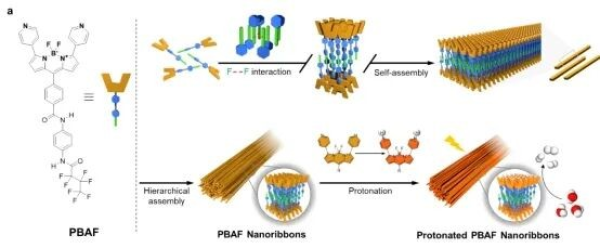
Schematic Illustration of the Preparation and Hydrogen Production of a Biomimetic Chlorosome-Inspired Photosynthetic Assembly Based on Fluorinated BODIPY-Based Nanoribbons
Natural chlorosomes in photosynthetic organisms achieve nearly 100% energy transfer efficiency through a protein-free molecular self-assembled array, providing an ideal blueprint for the design of artificial photosynthetic systems. A research team from the Shanghai Institute of Organic Chemistry, Chinese Academy of Sciences, has made a significant breakthrough in the field of artificial photosynthetic assemblies.
Inspired by the chlorosome structure, the team designed an amphiphilic fluorinated BODIPY molecule. Driven by fluorine-fluorine interactions, these molecules self-assembled into tightly packed supramolecular nanoribbons, forming a hierarchical photosynthetic assembly capable of photocatalytic hydrogen production—all without the need for a protein scaffold or metal catalysts. The fluorine-induced molecular packing not only enhanced the system's light-harvesting capacity and structural stability but also effectively promoted charge separation and prolonged the lifetime of photoactive intermediates, thereby providing an ample time window for catalytic reactions. After optimization, the system achieved a maximum hydrogen evolution rate of 1150 μmol·g⁻¹·h⁻¹, surpassing most benchmark systems of its kind. It maintained high activity under simulated sunlight for 30 consecutive days and retained over 90% of its initial activity after five cycles, demonstrating excellent stability and recyclability.
This research successfully replicates the core structural features of natural chlorosomes and elucidates the key mechanism of array-enhanced photocatalysis. It provides crucial support for the construction of high-performance biomimetic artificial photosynthetic systems.