Weekly Advanced Technologies〔47〕

Weekly Advanced Technologies〔47〕丨The First Approach to the Theoretical Limit of Energy Storage Density in Lithium Batteries丨Breakthrough in Key Process for Two-Dimensional Semiconductors!
How might one engineer a smartphone's lithium battery to be both compact and enduring? This question, when articulated in scientific terms, becomes: How can lithium batteries achieve a high and consistent energy storage density alongside a robust power density? This necessitates the development of anode materials capable of accommodating a greater number of lithium ions within a minimal volume, while also facilitating rapid and reversible charge-discharge cycles.
Professor Pan Feng's team from the School of Advanced Materials, Peking University Shenzhen Graduate School has achieved a significant breakthrough in the research and development of lithium cobalt anode materials for lithium batteries, bringing the energy storage density close to the theoretical limit for the first time.
Two-dimensional (2D) semiconductors boast the advantages of an atomically thin structure and high mobility, capturing the interest of the world's foremost semiconductor chip companies and research institutions. The group led by Peng Lianmao and Qiu Chenguang at the School of Electronics, Peking University, has advanced a novel theory regarding the integration process of 2D semiconductors and has innovated an atomic-level precise selective zone doping technology. This breakthrough enables the realization of ideal ohmic contact and switching characteristics, positioning it as a promising candidate for constructing future chips with enhanced performance and reduced power consumption at the sub-1nm technology node.
1. Advanced Materials丨How might one engineer a smartphone's lithium battery to be both compact and enduring? The First Approach to the Theoretical Limit of Energy Storage Density in Lithium Batteries
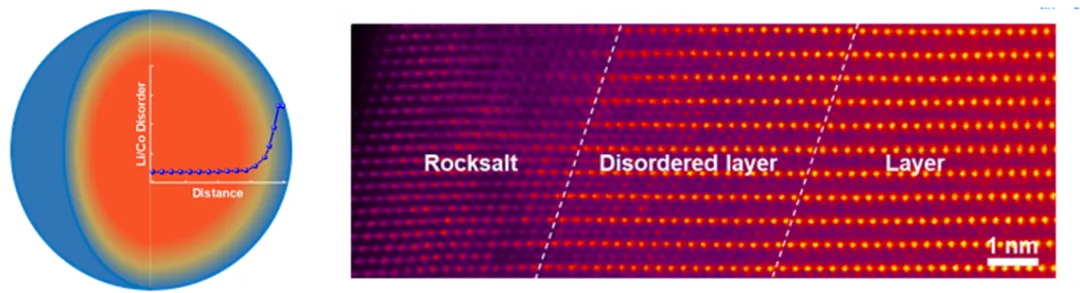
Disordered structure of lithium cobaltate from interface to bulk phase gradient
How might one engineer a smartphone's lithium battery to be both compact and enduring? This question, when articulated in scientific terms, becomes: How can lithium batteries achieve a high and consistent energy storage density alongside a robust power density? This necessitates the development of anode materials capable of accommodating a greater number of lithium ions within a minimal volume, while also facilitating rapid and reversible charge-discharge cycles.
Commercial lithium cell phone battery cathode materials typically consist of lithium cobaltate layered oxides, which possess a theoretical reversible specific capacity of 274 mAhg-1 when all lithium ions are stripped out and embedded. Elevating the operating voltage enables the extraction of an increasing number of lithium ions from the lattice. However, this structure is susceptible to irreversible transition metal cobalt ion migration and unstable oxygen anion loss, leading to detrimental irreversible structural phase transitions and oxygen release behaviors. Consequently, for an extended period, only 50-60% of the lithium within a layered structure like lithium cobalt oxide (LCO) can be reversibly de-embedded during charging and discharging, corresponding to a reversible capacity of 140-165 mAhg-1.
Professor Pan Feng's team from the School of Advanced Materials, Peking University Shenzhen Graduate School has achieved a significant breakthrough in the research and development of lithium cobalt anode materials for lithium batteries, bringing the energy storage density close to the theoretical limit for the first time. The team has innovatively designed a gradient disordered structure of lithium cobalt oxide cathode (GDLCO), which addresses the long-standing issue of mechanical and chemical failure induced by high voltage charging and discharging, triggered by stress concentration in laminated cathodes. This cathode material features low interfacial impedance and high effective voltage, demonstrating strong resistance to chemical-mechanical strain. It effectively inhibits the formation of microcracks, minimizes the occurrence of interfacial side reactions, and alleviates the irreversible phase transition of the material at high voltage.
This electrode material elevates the utilization rate of lithium in lithium cobaltate to 93% (256 mAhg-1, nearing the theoretical capacity), and also exhibits superior cycling stability compared to existing high-voltage lithium cobaltate materials. These exceptional properties are also well-suited for UAV batteries that demand high energy and power. The research team is progressing towards the industrialization of this new material. This breakthrough is also contributing to the further development of practical, high-performance new cathode materials.
2. Nature Electronics丨Breakthrough in Key Lab-to-Fab Process for Two-Dimensional Semiconductors!
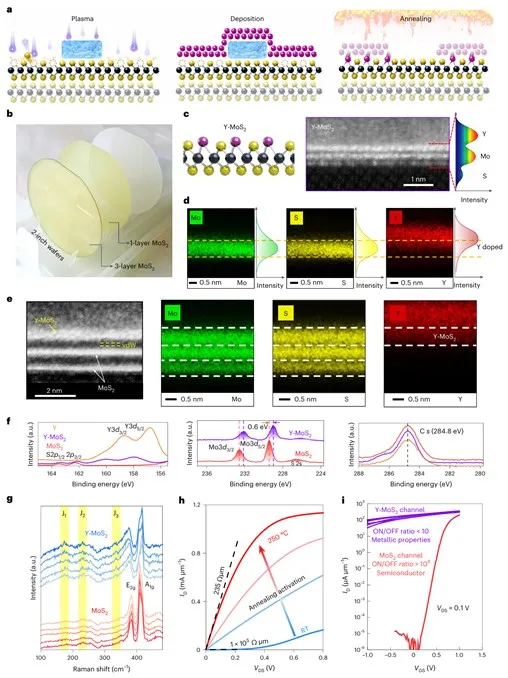
Systematic characterization of atomic-level doping-induced two-dimensional metallization
Traditional silicon-based technology is nearing its physical limits at the sub-3nm node, while two-dimensional (2D) semiconductors are considered promising channel materials for sub-1nm technology node integrated circuit chips and have recently garnered attention from leading global semiconductor chip companies and research institutions. 2D semiconductors offer an atomically thin structure and high mobility advantages, enabling superior electrostatic control and on-state characteristics in ultrashort channel transistors.
At this stage, achieving ohmic contacts between 2D semiconductors and metal electrodes will be a critical factor in fabricating high-performance ballistic transistors. Additionally, most high-performance 2D transistors currently realized internationally are based on mechanically exfoliated or centimeter-scale 2D single crystals. Therefore, scaling up the fabrication of high-performance transistors based on wafer-scale 2D semiconductors is also a core challenge in driving 2D electronics from laboratory research to industrial application (Lab-to-Fab).
Recently, the team led by Professors PENG Lianmeng and QIU Chenguang from the School of Electronics at Peking University has proposed the "rare earth yttrium element-induced phase transition theory" in the field of 2D semiconductor integration processes, and invented an atomically precise selective doping technology. This technology has broken through the engineering limitation of traditional ion implantation doping where the junction depth cannot be less than 5 nanometers, for the first time pushing the doping depth in the source-drain selection area to the limit of a single atomic layer, 0.5 nanometers. Based on this, wafer-scale fabrication of ultrashort channel ballistic transistors using 2D semiconductors has been achieved, realizing ideal ohmic contacts and switching characteristics, which holds the potential to construct future chips with higher performance and lower power consumption at the sub-1 nanometer technology node.
3. Cell Reports丨It Has Been Proven that There are Multiple Pathways to "Emotional Empathy"
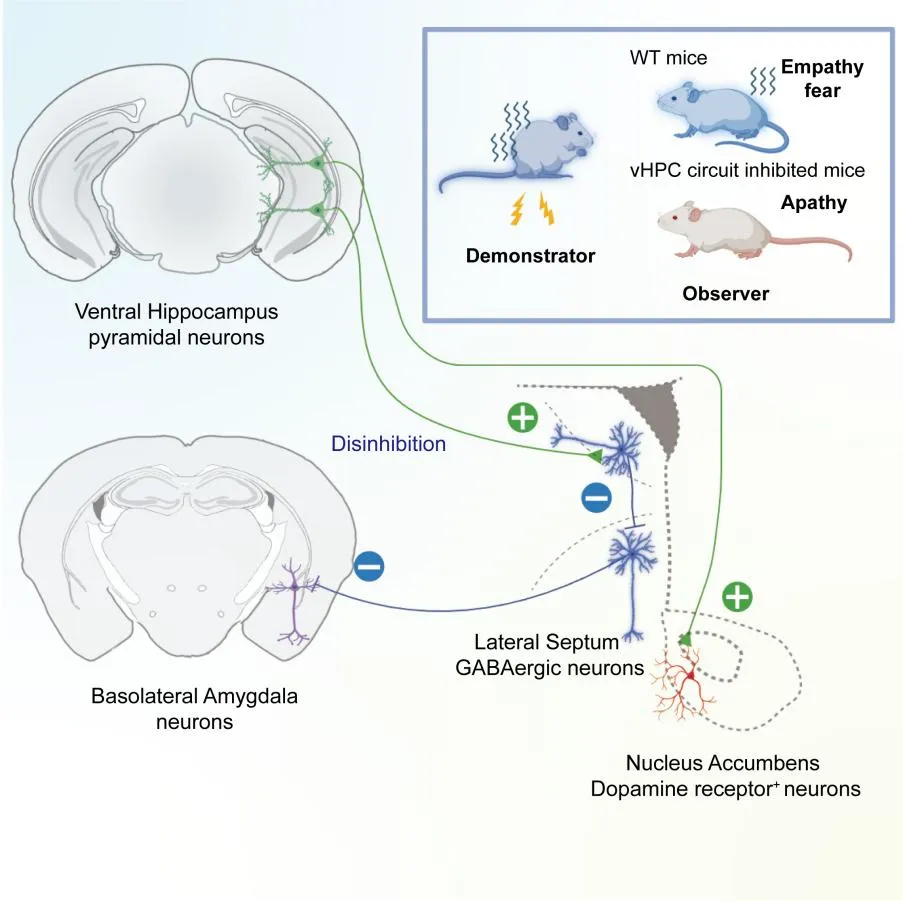
Graphical abstract
When a person is described as "empathetic," it typically implies that they possess the capacity to resonate with the emotions, feelings, and mental processes of others. Scientifically, emotional empathy denotes the skill to recognize and mirror the emotional states of others, a crucial faculty that underpins the social dynamics of animals and the perpetuation of their species. Individuals afflicted with social dysfunctions, such as autism or post-traumatic stress disorder, often exhibit impairments or heightened sensitivity in their empathic capabilities. Consequently, delving into the neural underpinnings of empathy holds significant importance for the accurate diagnosis and effective treatment of these conditions.
The research team led by Professor XIE Wei at the School of Life Sciences and Technology, Southeast University, has utilized experimental methods such as active population-targeted recombination systems, optogenetics, chemogenetics, and two-photon calcium imaging recording to discover two neural circuits with independent functions that regulate observational fear empathy (OF). Specifically, the OF Freeze encoding neurons in the ventral hippocampus (vHPC) activate the dorsal-ventral LS GABAergic neurons to the BLA, exerting an inhibitory release function. Moreover, the BLA serves as the fear effector in the vHPC→LS→BLA circuit, regulating OF. Additionally, there is another functionally independent circuit, vHPC→NAc, that also modulates OF. This discovery by the research team broadens the study of the neural network of emotional empathy and provides new clues for understanding the potential mechanisms of empathy-related emotional disorders.
4. J. Am. Chem. Soc.丨176 Years Later: They Take Up the Scientific Baton from Louis Pasteur
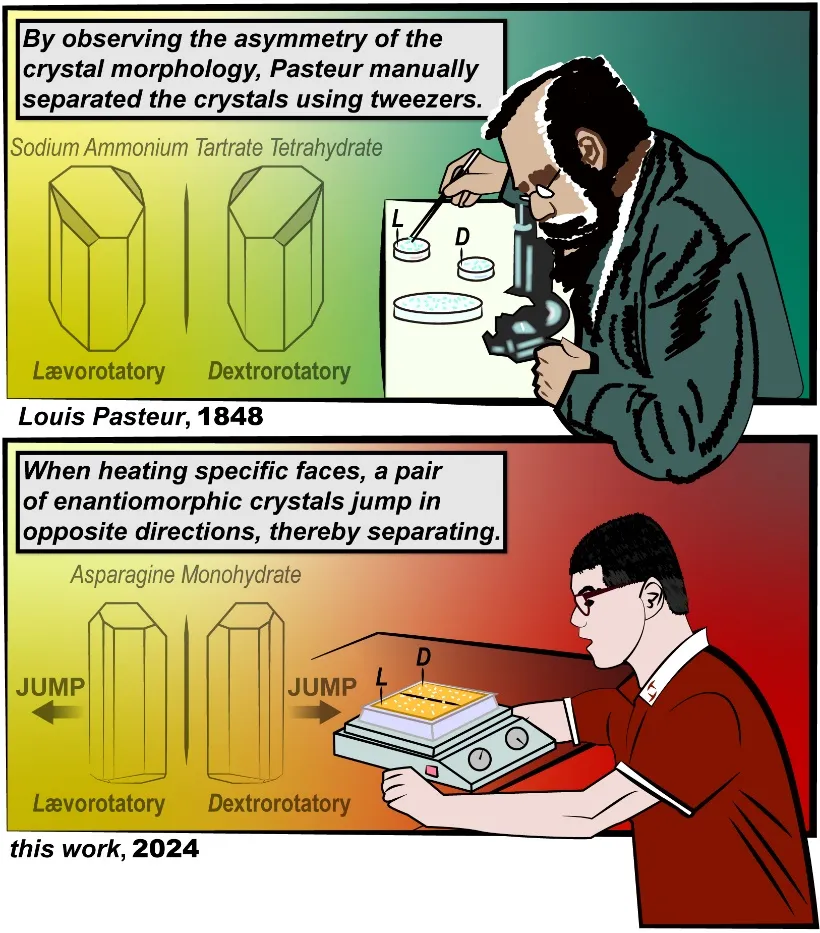
This work bears a historic connection to Pasteur's resolution experiment
In 1848, Louis Pasteur, during his investigation into the crystallization of tartrates, astutely noticed the asymmetry in their crystal forms: two types of crystals exhibiting mirror-image morphological characteristics (i.e., tartrate crystals of opposite chirality) were simultaneously precipitated from the solution. Utilizing this morphological distinction, Pasteur meticulously separated the crystals of the racemic mixture of sodium ammonium tartrate tetrahydrate by hand, employing tweezers. This pioneering work not only marked the first chiral separation experiment in the annals of human science and technology but also established the groundwork for stereochemistry. Its elegance, simplicity, and profound significance led to its selection as the most beautiful chemistry experiment by Chemical & Engineering News magazine.
176 years later, today, the team led by WAN Xinhua and ZHANG Jie at the School of Chemistry and Molecular Engineering, Peking University, has taken up this scientific relay. They have achieved enantiomer separation by heating specific crystal faces of chiral crystals, causing them to leap in different directions.
The team designed and constructed a dynamic crystal system based on a racemic mixture of asparagine monohydrate. Upon heating the hydrate single crystals, the lattice water is removed from the system, driving the crystals into motion. When specific crystal faces of a pair of enantiomeric single crystals are heated, the crystals of opposite chirality show a macroscopic motion behavior of jumping in the opposite direction, which in turn allows for the mechanical splitting of chiral crystals.
Further structural analysis shows that asparagine molecules form an intermolecular hydrogen bonding network in specific directions, which provides a directional channel for the thermal escape of water molecules; the escape paths of water molecules in the enantiomeric crystals are completely mirrored, which lays the foundation for the directional jumping behavior of the crystals.
5. Science丨This Crassula Muscosa Plant Provides a Perfect Bionic Blueprint for Intelligent Liquid Manipulation

Crassula muscosa
The directional transport of liquids on solid surfaces holds an extremely significant role across various sectors, including biomedicine, aerospace, agricultural production, and industrial manufacturing. The directional transport phenomena exhibited by natural organisms serve as an excellent blueprint for intelligent liquid manipulation. For instance, cacti channel collected mist from the tips of their spines towards their roots; spider silks direct captured mist from periodic spindle knots to their joints; lizards utilize interconnected capillary channels to transport water into their mouths; hogweeds employ multi-scale structures to direct rainwater and nectar from the inner edge of their beaks to the outer edge; and Nannywort leaves leverage the capillary serration effect to transport specific liquids in a predetermined direction. Scientific research has demonstrated that all these biological systems share a common pattern: fluids can only be transported directionally in a fixed direction.
However, the latest findings by LI Jiaqian from Shandong University and WANG Liqiu's team at the Hong Kong Polytechnic University have challenged this conventional understanding. They discovered that when watering Crassula muscosa, a succulent plant, the liquid can spontaneously flow unidirectionally towards either the stem tip or the root, depending on the horizontal orientation of the stem, a phenomenon that starkly contrasts with the traditional belief that a liquid can only flow in a fixed direction.
Crassula muscosa, native to the arid yet foggy regions of South Africa and Namibia, benefits from its environment as its stems and leaves readily absorb moisture from the fog, capturing droplets and ensuring ample hydration for its growth. The research team has initially documented the remarkable liquid manipulation capabilities of crassula muscosa, attributing this phenomenon to the unique asymmetric folding structure of its leaves.
These leaves feature distinct folding angles at their extremities: an upward angle towards the stem tip and a downward angle towards the root. This asymmetry results in a variation in the liquid-curving surface in opposite directions, enabling the selective movement of liquid in different directions. This study not only unveils a unique liquid transport phenomenon and its underlying mechanism in nature but also offers fresh insights and approaches for developing more flexible and efficient smart liquid manipulation devices for engineering applications.
The research team employed three-dimensional printing to fabricate a device that emulates the structure of a wakame leaf. Within this wakame-inspired device, which features varying folding angles, liquid exhibits bidirectional flow—positive and negative—mirroring the directional liquid transport observed in wakame plants. Through the development of a theoretical model grounded in anisotropic curved liquid surfaces, the team elucidated the intrinsic mechanism by which the liquid flow direction can be precisely controlled through adjustments to the foldback angle and spacing.
Drawing inspiration from this, the research team has engineered magnetically controlled and flexible wakame-like smart devices that adeptly manage the liquid flow direction via magnetic fields and mechanical stretching. These devices showcase the potential of wakame-inspired smart technologies to flexibly control liquid transport, positioning them for extensive applications in biomedicine, microreactor systems, microfluidic control, and wearable electronic devices.