Weekly Advanced Technologies〔65〕

Weekly Advanced Technologies〔65〕丨AI Technology Contributes to Solving the Problems of Long-Period Climate Prediction; Crossing Species Boundaries, VDGE Unlocks a New Method for Gene-Edited Animal Research
So far, long-period climate variability has been hard to be effectively predicted because of its long duration, complex mechanisms and the still inadequate understanding of its changing factors. Recently, XU Yongsheng's team at the Institute of Oceanography, Chinese Academy of Sciences, has made a breakthrough in using artificial intelligence to improve the prediction ability of the Pacific Decadal Oscillation.
Genetically-edited animals play an important role in bioscience and medical research and show potential for practical applications in the agricultural field. With the development of gene-editing technology, the number of genetically-edited animals has increased rapidly. Currently, there is a relative lack of collation, summarization and standardized analysis of data on genetically-edited animals, which restricts researchers from mining and using these data. In response to this, a research team of the Chinese Academy of Sciences has carried out relevant explorations.
Based on the weekly diary of technology provided by the daily list of the NCSTI online service platform, we launch the column "Weekly Advanced Technologies" at the hotlist of sci-tech innovation. Today, let's check out No.65.
1. Environmental Research Letters丨AI Technology Contributes to Solving the Problems of Long - period Climate Prediction
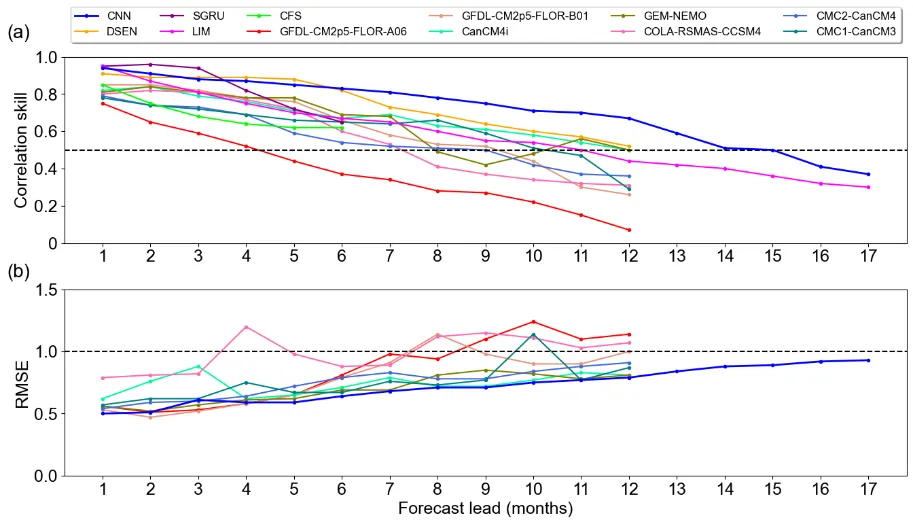
(a) The correlation and (b) RMSE of the annual mean PDO index at different lead months for the CNN model (blue) are compared with the annual mean PDO index and RMSE from dynamic forecast systems from the NMME (other colours).
Effective prediction of long-period climate variability has so far been difficult to achieve because of its long duration and complex mechanisms, as well as the still insufficient understanding of its change factors.
Recently, XU Yongsheng's team at the Institute of Oceanography, Chinese Academy of Sciences has proposed a transfer-learning-enhanced convolutional neural network (CNN) to tackle complex ocean dynamic forecasting and predict PDO (Pacific Decadal Oscillation) events with up to a one-year lead time. The PDO is an El Niño - like pattern of climate variability that endures for a long time and has extensive and profound impacts on climate and ecosystems. The PDO has a long period of approximately 20 to 30 years. An accurate prediction of the PDO offers an important scientific basis for decision-makers to deal with its impacts. Nevertheless, because of its long - term nature and complex formation mechanism, the prediction of the PDO still encounters significant challenges.
The team addressed the limited amount of data by employing k-fold cross-validation to assess the model's performance on different datasets, thus enhancing the model's reliability. During the testing phase from 1983 to 2022, the CNN model enhanced with transfer learning consistently outperforms existing dynamical forecasting systems in predicting the annual mean PDO index and PDO phase, while demonstrating excellent forecasting performance by reducing the uncertainty associated with seasonal variations.
One of the major challenges that artificial intelligence encounters in predicting long-period climate variability is the lack of sufficient historical data for effectively training models. To address this issue, XU's team innovatively adopted a transfer-learning-enhanced CNN approach to predict the PDO. This method effectively overcomes the limitation of data insufficiency by extracting existing knowledge from pre - trained models and applying it to new relevant tasks. Generally, training deep CNN models demands a large amount of labeled data to attain good generalization capabilities.
However, by making use of pre-trained networks, high accuracy can still be achieved even with extremely limited data samples. The method proposed in this study utilizes the dynamical information in the model data to make up for the shortage of observational data, successfully accomplishes the prediction of the PDO, and offers a new approach for the prediction of long-period climate variability.
2. Nucleic Acids Research丨Crossing Species Boundaries, VDGE Unlocks a New Method for Gene-Edited Animal Research
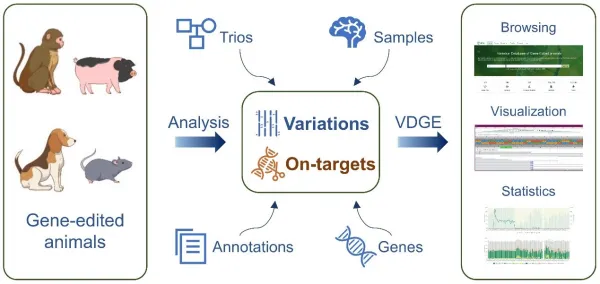
VDGE database construction process and content demonstration
Gene-edited animals play a significant role in bioscience and medical research and demonstrate potential for practical applications in agriculture. As gene-editing technology develops, the number of gene-edited animals is increasing rapidly. The academic community is becoming more and more concerned about the impact of gene-editing systems on biological genomes and the possible emergence of de novo mutations in gene-edited animals. Currently, there is a relative shortage of data on gene-edited animals in terms of collation, aggregation, and standardized analysis, which restricts researchers from mining and using these data.
Recently, the ZHAO Wenming team from Beijing Institute of Genomics Chinese Academy of Sciences (China National Center For Bioinformation), the Wang Guodong research group from Kunming Institute of Zoology, and the Zhang Yongqing research group from Institute of Genetics and Developmental Biology, Chinese Academy of Sciences started from laboratory gene-edited monkeys and gene-edited dogs. They collected, sorted out, and analyzed the relevant data sets currently having whole-genome data of pedigrees, and constructed the de novo mutation database for gene-edited animals (VDGE), achieving the standardized analysis, integration, and presentation of de novo mutations in gene-edited animals, and providing a comprehensive information platform for the mining and utilization of relevant data.
VDGE consists of six key modules: species, lineages, samples, target mutations, variants and related genes. Currently, the main body of VDGE data comes from related datasets with whole genome sequencing data of family lines, covering 107 animal family lines, 174 whole genome sequencing samples, 56 target mutations, 115,710 variants, and 12,708 related genes of rhesus monkeys, crab monkeys, and canines, among other species. At the same time, VDGE has integrated information on gene-edited pigs and dogs that lack whole genome sequencing data, as well as the target mutations associated with them. In the future, VDGE will integrate more gene-edited species and multiple types of mutation data to provide researchers with a more comprehensive and diversified data resource platform.
3. Advanced Materials丨Great Progress in Carbon Anode Materials for Sodium-ion Batteries with Long Lifespan and High Capacity
With the transformation of the global energy structure and the ever-increasing demand for renewable energy, efficient and environmentally-friendly energy-storage technologies have become a hot research topic. Although lithium - ion batteries have been widely utilized in various fields, the scarcity and uneven distribution of lithium resources restrict their further development. Sodium-ion batteries are considered as a promising alternative technology on account of their abundant sodium resources and the similar working principle to that of lithium-ion batteries.
However, sodium-ion batteries still face many challenges on the road to commercialization, especially the low initial coulombic efficiency of carbonaceous anode materials during charging and discharging and the lack of clarity of the sodium storage mechanism, which severely limit the performance and reliability of sodium-ion batteries. In order to solve these problems, researchers have been exploring new carbonaceous materials and attempting to gain a deeper understanding of the sodium storage mechanism through advanced characterization techniques, with a view to designing high-performance carbon anode materials.
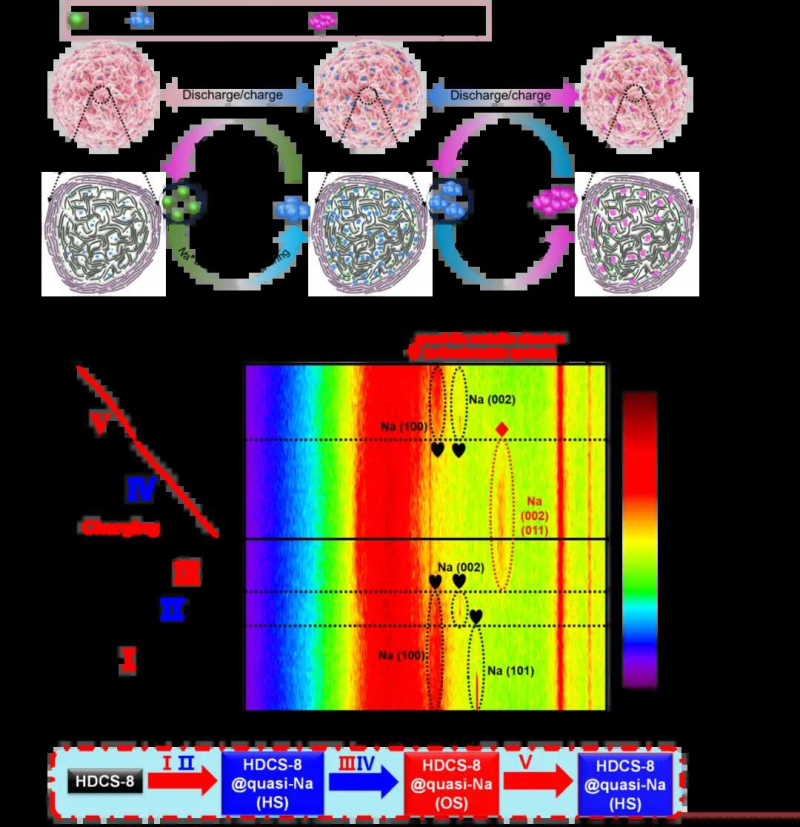
Recently, the Confucius Energy Storage Lab led by Professor WU Yuping from the School of Energy and Environment, Southeast University, has developed a rationally designed highly defective ultrathin carbon nanosheets (HDCS) anode, which has a strong Na+ self-adsorption behavior, and its sodium-storage mechanism has been revealed in detail. Through in-situ XRD, the unique sodium-storage mechanism of quasi-sodium-metal clusters adsorbed on the HDCS-8 anode and the crystal system transformation have been directly observed. During the discharging process, small hexagonal quasi-sodium-metal clusters are first formed in the high-voltage region, and then they are transformed into larger orthorhombic quasi-sodium-metal clusters in the low-voltage region.
HDCS-8 presents this unique sodium-storage mechanism, endowing it with excellent performance. The HDCS-8 negative electrode has a high reversible capacity of 364 mAh g⁻¹. It can retain 100% of its capacity after 1000 cycles at 1.0 A g⁻¹ and still maintain 94% of its capacity after 600 cycles at a high current density of 5.0 A g⁻¹. Consequently, this unique mechanism of quasi-sodium-metal-cluster adsorption and crystal-system transformation offers a promising development direction for sodium storage and promotes the future development of carbonaceous anode materials with long lifespan and high capacity.
4. Environmental Technology & Innovation丨New Developments in Microbial Communities: Oyster Shells and Biochar Jointly Promote Ecological Circulation
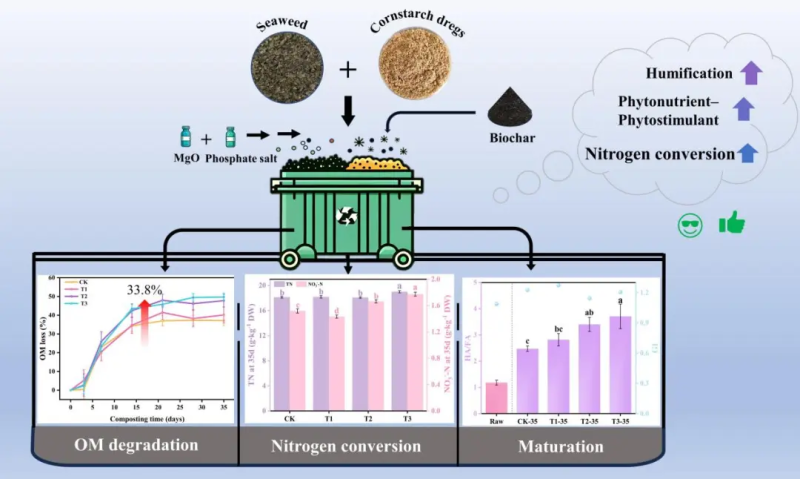
Effect of additives on seaweed composting
With the development of the global aquaculture industry, a large amount of waste such as seaweed and oyster shells is generated every year. These wastes are usually piled up in landfills, on the beaches near the sea or directly discarded into the ocean, which has an environmental impact on the soil, natural waters and marine ecosystems. In order to promote the sustainable development of aquaculture, the team led by FENG Dawei at the Yantai Institute of Coastal Zone Research, Chinese Academy of Sciences has made progress in the research on the resource utilization of wastes such as seaweed and oyster shells and soil improvement technologies.
The research team explored how to convert wastes such as seaweed, corn starch residue, chicken manure, corn stover, and oyster shells into valuable resources. First, additives such as biochar, phosphate, and magnesium oxide were added to the composting system of seaweed and corn starch residue, which significantly improved the organic matter decomposition efficiency, nitrogen conversion rate, and humification level of the composting process while maintaining or enhancing the phytostimulant effect of the seaweed.
Secondly, for the composting system of chicken manure and corn stover, it was found that the addition of 40% oyster shell powder could effectively improve the acidic soil and promote the growth of oilseed rape, as well as improve the efficiency of organic matter degradation and the activation rate of calcium.
Finally, during the co-composting process of seaweed and sugar residue, the research team compared the impacts of different ratios of biochar and oyster shell powder on the composting effect. The results indicated that an appropriate amount of biochar could significantly enhance the degradation efficiency of organic matter and the proportion of humus, while oyster shell powder was helpful for reducing the total amount of waste and maintaining the quality of the compost.
5. Nature Chemistry丨Chemical Fuels-Driven: Droplets are Able to "Run" as Well
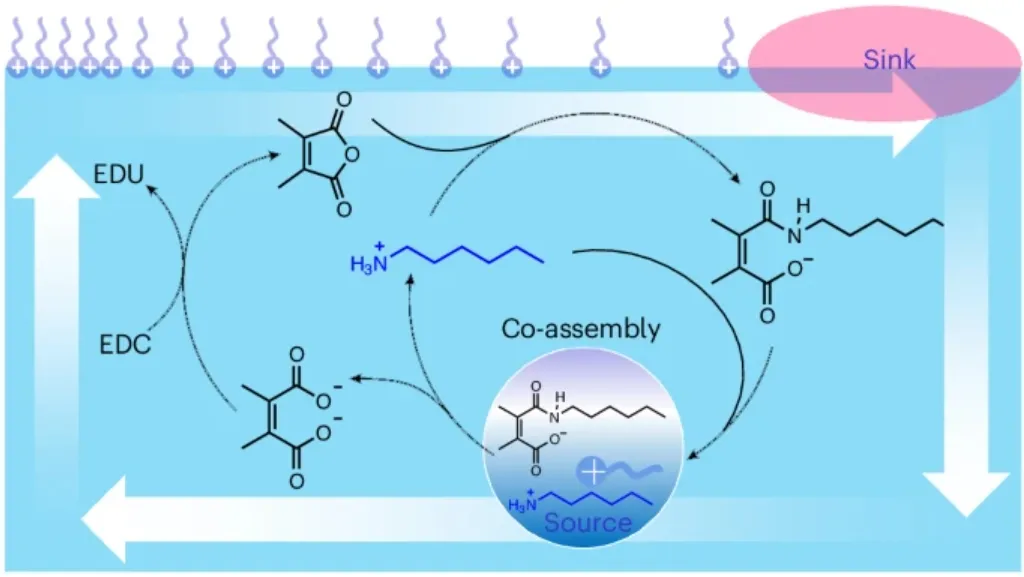
Schrödinger proposed that life thrives on negentropy. Prigogine put forward the theory of dissipative structures, further expounding on the role of energy in the evolution of ordered structures. Biological assemblies display this energy-dissipation property. Currently, by means of chemistry, scientists have constructed a variety of dissipative assembly systems to obtain transient structures and properties. By contrast, emergent functions far from the equilibrium state, such as mechanical functions, are relatively scarce.
Therefore, it is necessary to expand the research paradigm of dissipative assembly to explore the unique properties and behaviors resulting from energy dissipation, which will contribute to the development of complex functions and deepen scientists' understanding of the vitality of life.
Researcher LIU Kai from the Shenzhen Institutes of Advanced Technology, Chinese Academy of Sciences and the research team Sijbren Otto from the University of Groningen have jointly proposed an approach to transient amide bond formation and use it to harness chemical energy and convert it to mechanical motion by integrating dissipative self-assembly and the Marangoni effect in a source–sink system.
Carbodiimide acts as an additional fuel molecule that facilitates the regeneration of amides from diacid waste with octylamine, forming a dissipative reaction network. These amide compounds are assembled with octylamine through intermolecular forces to form droplets in which hydrophobic regions are able to accelerate the reaction and produce autocatalytic growth.
By regulating the supply of chemical fuel, the researchers achieved the dynamic control of droplet growth and disappearance, showing periodic growth and regeneration characteristics. Moreover, they made use of the chemical interaction between the droplets and oleic acid to endow the droplets with the chemotactic movement ability. After hydrolysis, the octylamine in the droplets is absorbed by oleic acid, leading to a difference in surface tension. With the assistance of the Marangoni effect, the droplets move towards oleic acid. This process can be controlled by adjusting the addition of fuel molecules to regulate the speed and duration of droplet movement.
This study has not only demonstrated the possibility of realizing mechanical work in dissipative assembly systems, but also constructed an active droplet system capable of cross-scale energy conversion by integrating dissipative assembly and the Marangoni effect. This system has provided new ideas for the development of novel active materials, as well as an important reference for understanding the energy dissipation mechanism in living systems.
6. Advanced Materials丨Simulating Ant-Nest Structure to Achieve Self-Starting Super-Hydrophobicity on Metal Surfaces
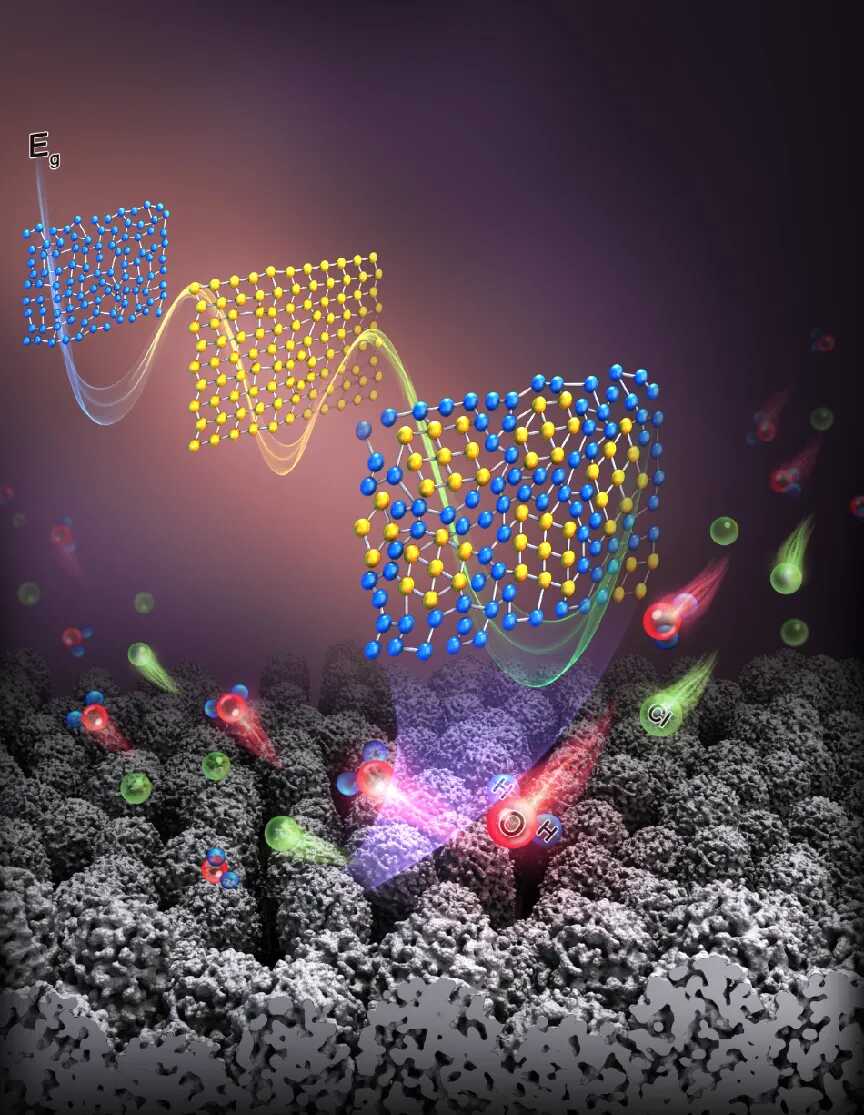
The progress in Femtosecond laser preparation of uncoated and durable superhydrophobic surfaces made by Changchun Institute of Optics, Fine Mechanics and Physics, Chinese Academy of Sciences and other institutions.
Superhydrophobicity on metal surfaces has potential applications in self-cleaning, corrosion protection, drag reduction and anti-icing. Currently, the achievement of superhydrophobic properties on metal surfaces depends on the traditional binary co-design concept, that is, creating micro/nanostructures on the material surface and then modifying them with low-surface-energy organic substances.
This design based on adherent coatings is vulnerable to the penetration of aggressive ions in real corrosive environments such as seawater, resulting in the risk of coating decomposition, loosening and flaking, which causes the degradation of superhydrophobic chemical durability. In particular, changes in the surface energy of the material induced by chemical reactions have an impact on the liquid roll-off angle, making it difficult to maintain superhydrophobic surface properties over long time periods.
The team led by YANG Jianjun from Changchun Institute of Optics, Fine Mechanics and Physics, Chinese Academy of Sciences proposed a research method that combines femtosecond laser element-doped micro-and nano-structures with cyclic low-temperature annealing. A bionic ant-nest-like structure dominated by sub-crystalline phases was constructed on the surface of the metal aluminum alloy, achieving highly efficient and stable self-starting super-hydrophobic effects.
Among them, the multi-level micro- and nano-structures are helpful for the stable utilization of air capture, and the formation of sub-crystalline phases can reduce the free energy on the material surface, thus making the metal surface exhibit super-hydrophobic chemical stability. The research found that this self-starting super-hydrophobic metal surface can meet the challenges of harsh environments such as soaking in different acid-base solutions, ultraviolet radiation and freezing-thawing cycles.
Furthermore, this team cooperated with the team led by Ma Hui from the Institute of Metal Research, Chinese Academy of Sciences. They used the ab initio calculation method to further verify theoretically the contribution of the formation of sub-crystalline phases to the reduction of material surface energy and the improvement of chemical stability at the theoretical level.
The above-mentioned research has solved the problem of long-lasting extreme water-repellency on metal surfaces and provided new research ideas for the design and development of high-performance material surfaces based on atomic-scale regulation.
Columnist: Li Xiaoxiao
Translator: Liu Kaiyuan