Weekly Advanced Technologies〔96〕
Weekly Advanced Technologies〔96〕 | Biodegradable Wireless Sensors Enable Dynamic Monitoring of Deep Tissues; Phase Pixel Optical Computing Unit Achieves Near 91% Recognition Accuracy
The development of high-energy-density batteries using metal fluoride cathodes has been impeded by their dissolution and structural degradation in harsh, high-temperature molten salt electrolytes. A recent breakthrough by researchers from the Institute of Process Engineering, Chinese Academy of Sciences, addresses this through a novel "Selective Confinement" strategy. By creating a functional interface with uniform sub-nanochannels on the cathode surface, the design acts as an intelligent "ion sieve," effectively blocking harmful dissolved species while enabling efficient lithium-ion transport. This innovation not only resolves the long-standing dissolution problem but also improves reaction kinetics and cycling stability. Beyond offering a practical solution for metal fluoride cathodes, the work establishes a new paradigm of precise interfacial engineering, shifting the focus from material discovery to controlled ion management and paving the way for future advanced energy storage systems.
Based on the weekly diary of technology provided by the daily list of the NCSTI online service platform, we launch the column "Weekly Advanced Technologies" at the hotlist of sci-tech innovation. Today, let's check out No.96.
1. Nature丨Biodegradable Wireless Sensors Enable Dynamic Monitoring of Deep Tissues

Flexible Biodegradable Wireless Sensing Platform and Its Signal Schematic
Acquiring dynamic physiological data from deep tissues is critical for intensive care and post-operative management, yet existing external measurement or imaging technologies struggle to capture such information in real time. While implantable devices hold promise, conventional solutions relying on batteries or magnets pose safety risks. Furthermore, existing passive inductor-capacitor (LC) biodegradable sensors are limited by short readout distances and poor signal robustness.
To address these challenges, a research team led by the Institute of Mechanics, Chinese Academy of Sciences, has developed a flexible, biodegradable wireless sensing platform. This platform can stably monitor various physiological signals, such as pressure and temperature, over long distances, while maintaining high accuracy across a wide range of measurement distances and angle variations. The system innovatively employs a "pole-moving scanning" readout mechanism, reducing the required coupling efficiency to a level of 10⁻⁵. This breakthrough overcomes the bottlenecks in readout distance and signal stability typical of passive wireless sensing.
Through a synergistic mechanics-electromagnetism design featuring an integrated folding structure, the platform achieves excellent electromagnetic performance while ensuring material flexibility and biodegradability. In vivo experiments within an equine abdominal cavity demonstrated that the sensor could reliably capture pressure and temperature changes in deep tissues without requiring precise positioning, showcasing its practical advantage for deployment in complex clinical environments.
This technology holds significant promise as a valuable complement to medical imaging, with potential applications in various scenarios including intra-abdominal hypertension monitoring, post-coronary artery bypass graft surgery surveillance, and intensive care management for brain diseases.
2. Advanced Photonics丨Phase Pixel Optical Computing Unit Achieves Near 91% Recognition Accuracy
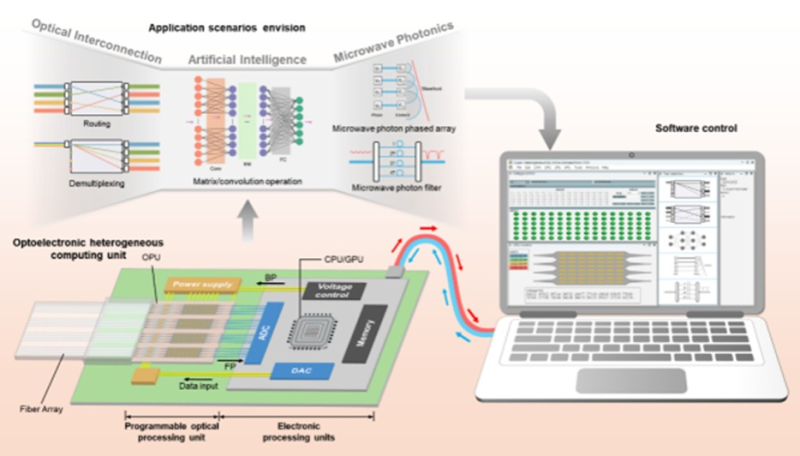
Research Progress in High-Precision Optical Computing
Amidst the rapid development of artificial intelligence neural networks, the demands for large-scale matrix operations and frequent data iterations present severe challenges to traditional electronic computing hardware. Optoelectronic hybrid computing has garnered significant attention due to photons' inherent high bandwidth and parallel processing potential. However, the practical application of this technology has long been hampered by the decoupling of the training and inference phases, as well as the reliance on offline weight updates. This leads to information loss and precision degradation during computation, ultimately affecting the inference accuracy in practical tasks.
To tackle this challenge, a research team from the Institute of Semiconductors, Chinese Academy of Sciences (CAS), has proposed a programmable optical processing unit (OPU) based on a phase pixel array and enabled its flexible programming by integrating Lyapunov stability theory. Building upon this, the team constructed an End-to-End Closed-Loop Optoelectronic Hybrid Computing Architecture (ECA). Through hardware-algorithm co-design, this architecture for the first time achieves full-cycle closed-loop optimization encompassing both training and inference phases. It effectively compensates for information entropy loss, breaking the strong coupling limit between precision and accuracy in optical computing. The architecture also incorporates a noise self-learning mechanism, enabling joint optimization of optical and electrical parameters along with adaptive precision compensation.
Experimental results demonstrate that the ECA, using only a 4-bit OPU, achieves 90.8% accuracy on the MNIST handwritten digit recognition task, approaching the theoretical limit (90.9%) of traditional 8-bit computing architectures. The developed OPU operates at a speed of 30.67 GBaud/s, delivers a computing capacity of 981.3 GOPS, and achieves a remarkable computational density of 3.97 TOPS/mm². Theoretical analysis indicates the system can be scaled to a 128×128 array, boosting the computing capacity to 1005 TOPS, with a density of 4.09 TOPS/mm² and an energy efficiency as high as 37.81 fJ/MAC. This technology holds broad application prospects in fields such as microwave photonic signal processing, optical communication, and neuromorphic AI.
3. Science Advances丨Selective Confinement Cracks the Dissolution Puzzle of Metal Fluoride Cathodes
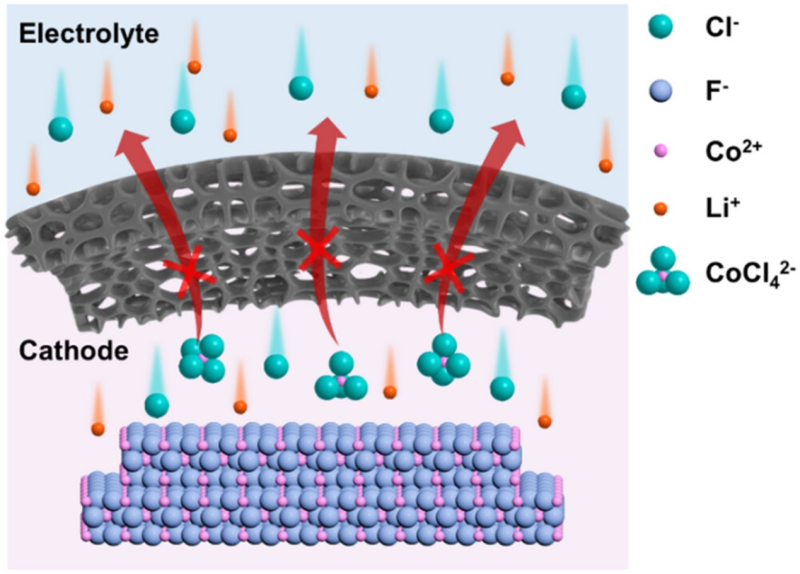
Illustration of size selective transmission of ions between electrolyte and cathode enabled by sub-nanoporous interface.
Transition metal fluoride (TMF), with their high theoretical voltage and excellent thermal stability due to fluorine's strong electronegativity, are considered ideal cathode materials for next-generation high-voltage thermal batteries. However, their low electronic conductivity, complex synthesis processes, and particularly their tendency to dissolve in high-temperature molten salt electrolytes have hindered practical applications. Especially at 500°C, the strong solvation effect of the molten salt promotes anion exchange between TMFs and LiCl, generating soluble complexes like CoCl₄²⁻, which leads to active material shuttling and electrode structure degradation.
To address this challenge, a research team from the Institute of Process Engineering, Chinese Academy of Sciences, has proposed a selective confinement strategy based on an "ion-sieving" principle. They in-situ constructed a covalent organic framework-derived carbon interface (CSC) with uniform 0.54 nm sub-nanochannels on the surface of cobalt difluoride (CoF₂) particles, forming a "plum pudding@shell" composite structure. This interface exploits the significant size difference between Li⁺ (~0.76 Å) and CoCl₄²⁻ (>5 Å), effectively blocking the outward migration of large complex ions while ensuring rapid lithium-ion transport.
Experimental results demonstrate that the CoF₂@CSC700-24 cathode exhibits outstanding performance at 500°C and a high current density of 100 mA cm⁻²: a discharge plateau exceeding 2.5 V, a specific capacity of 365 mAh g⁻¹, and a remarkably high specific energy of 882 Wh kg⁻¹—currently the highest reported value for high-voltage thermal batteries. Mechanistic studies combining thermodynamic calculations and Galvanostatic Intermittent Titration Technique (GITT) confirm that the CSC interface not only suppresses dissolution and shuttling but also stabilizes the lithium-ion diffusion coefficient, thereby enhancing reaction kinetics.
This work provides an innovative interface engineering solution for developing high-energy-density thermal batteries and related lithium-ion battery systems.