Weekly Advanced Technologies〔97〕
Weekly Advanced Technologies〔97〕 | Key Mechanism Behind Plant and Algal Carbon Capture Revealed; A Real-Data-Based Framework for Precise EV Range Forecasting
Scientific advancements are simultaneously deepening our understanding of natural processes and providing solutions to modern technological challenges. In the realm of synthetic biology, the structural resolution of a crucial transporter protein in the CO₂-concentrating mechanism of photosynthetic algae has revealed the secret behind their efficient carbon fixation, opening new avenues for improving crop photosynthesis. Concurrently, addressing a key barrier in sustainable transportation, researchers from the Chinese Academy of Sciences have developed a high-precision and interpretable EV range estimation framework. This model is built upon extensive real-world operational data, directly tackling the pervasive issue of unpredictable driving range for electric vehicles.
Based on the weekly diary of technology provided by the daily list of the NCSTI online service platform, we launch the column "Weekly Advanced Technologies" at the hotlist of sci-tech innovation. Today, let's check out No.97.
1. Nature Plants丨Key Mechanism Behind Plant and Algal Carbon Capture Revealed
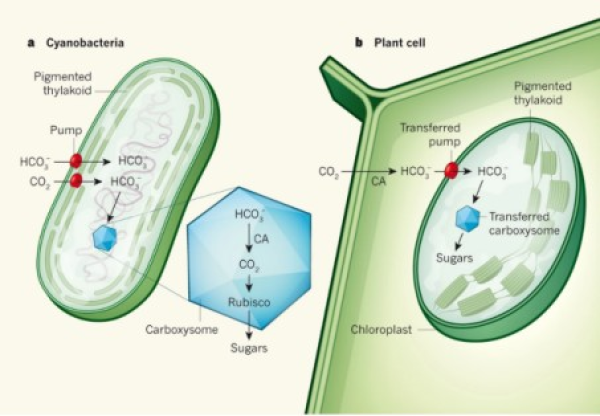
Schematic of Modifying Plant Chloroplasts by Integrating the Cyanobacterial CCM
A Research Team from the Center for Excellence in Molecular Plant Sciences, Chinese Academy of Sciences, has elucidated the substrate selectivity mechanism of the HCO₃⁻ transporter LciA within the CO₂-concentrating mechanism (CCM) of Chlamydomonas reinhardtii.
The team determined the high-resolution three-dimensional structure of LciA using cryo-electron microscopy. They discovered that Lys220 specifically recognizes the negatively charged HCO₃⁻ ion via electrostatic interactions, while Ala117 and Val267 form spatial constraints, collectively ensuring high substrate specificity. Functional experiments further validated that mutating residues K136A and A114F could significantly enhance the HCO₃⁻ transport activity of LciA, confirming the accuracy of the structural analysis. Guided by this structural blueprint, the team conducted rational design on the FNT and NAR1 protein families to which LciA belongs. On one hand, they successfully engineered the bacterial nitrite channel NirC into a novel element capable of HCO₃⁻ transport. On the other hand, they discovered that the chloroplast membrane proteins NAR1.1 and NAR1.5 from Chlamydomonas reinhardtii inherently possess HCO₃⁻ transport activity, and improved the transport efficiency of NAR1.1 through site-specific optimization.
This study not only clarifies the molecular basis of inorganic carbon recognition and transport in eukaryotic CCM but also achieves structure-guided rational engineering of HCO₃⁻ transporters. It provides crucial functional components and a feasible strategy for future endeavors to introduce algal CCM into C3 crops such as rice and wheat, aiming to break through the bottleneck of photosynthetic efficiency.
2. Applied Energy丨A Real-Data-Based Framework for Precise EV Range Forecasting
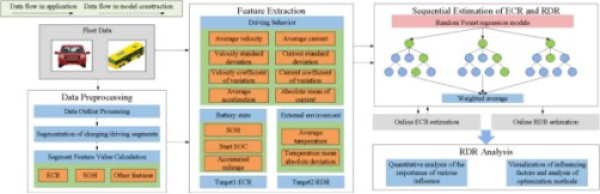
A Data-Driven Framework for Predicting and Optimizing Vehicle Range
To address the "range anxiety" challenge in electric vehicles (EVs), a research team from the Dalian Institute of Chemical Physics, Chinese Academy of Sciences, among other institutions, has proposed a novel framework for estimating and analyzing the remaining driving range of EVs based on real-world operational big data.
Traditional prediction methods, often based on laboratory test cycles or small-sample tests, struggle to account for the complex and variable factors encountered in actual driving, such as climate, road conditions, and driving habits. The team constructed an "Integrated Framework for Online Range Estimation and Optimization Analysis." They innovatively adopted a two-step strategy of "first energy consumption, then range": initially, a Random Forest algorithm was employed to integrate multi-source factors—including driving behavior, ambient temperature, and battery state of health—to establish a model for energy consumption per kilometer. This model then enables the precise calculation of the remaining range. This approach not only improves prediction accuracy but also enhances interpretability, allowing for the quantitative revelation of the degree of impact each factor has on range degradation. Validated against over three years of real-vehicle data covering more than 300,000 kilometers from multi-city passenger cars and buses, the results showed an average relative prediction error of below 5.5%, significantly outperforming traditional methods. The analysis identified average current and average speed as the key variables affecting energy consumption. It was found that merely by optimizing driving behavior, the range of passenger cars could be increased by over 30%, and that of buses by more than 10%.
This achievement not only answers "how far can it still go?" but also provides a quantitative basis for "how to go farther." It has potential applications in intelligent fleet dispatch, refined energy consumption management, and vehicle residual value assessment. For the next step, the research team plans to extend the study to harsh cold climates and complex road conditions. They aim to integrate more comprehensive environmental parameters and promote the deep integration of the algorithm with both on-board Battery Management Systems (BMS) and cloud platforms, thereby continuously contributing to more efficient and safer operation of new energy vehicle systems.
3. Science Advances丨Brain-Computer Interface Holds Promise for Restoring Speech in Chinese Patients with Aphasia
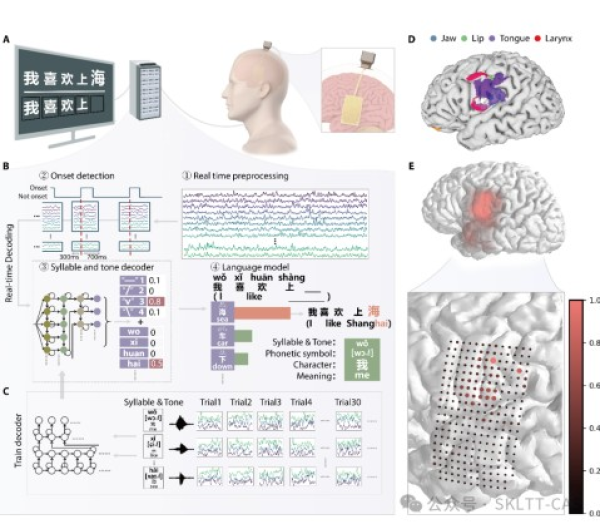
Real-time Mandarin Decoding Brain-Computer Interface System Framework and Electrode Contribution Characterization
A research team led by the Shanghai Institute of Microsystem and Information Technology, Chinese Academy of Sciences, has developed an implantable high-throughput flexible brain-computer interface (BCI) system and a real-time neural decoding algorithm for Mandarin. This breakthrough marks the world’s first successful real-time electrocorticography-based decoding and speech synthesis of Mandarin sentences via a BCI.
Unlike non-tonal languages such as English, which is primarily polysyllabic, Mandarin Chinese relies on a system of approximately 400 monosyllables combined with four lexical tones to form its common character set. The research team used these monosyllables and tones as the intermediate decoding units to construct a translation pathway from brainwave signals to written text. They simultaneously collected articulatory signals and high-quality electrocorticography (ECoG) signals from the High-γ frequency band (70–170 Hz). By aligning the onset of articulation using a 50-millisecond sliding window, a dual-stream decoder was employed to output probabilities for syllables and tones separately, which were then fused with a language model to generate complete sentences.
Experimental results showed that after nine days of training, the participants achieved an average pure neural decoding accuracy of 71.2% for 394 common Mandarin syllables. The latency for single-syllable decoding was only 65 milliseconds, enabling a real-time sentence output rate of 49.6 Chinese characters per minute. Furthermore, the team integrated this technology with artificial intelligence (AI) and embodied intelligence. Based on a self-developed general-purpose Brain-Computer Interface Operating System, the participants could drive a digital avatar to converse with a large language model and convert the decoded brainwave signals into commands to control a dexterous robotic hand in real-time, achieving highly efficient human-machine interaction.
This achievement provides critical technological support for restoring language function in Mandarin speakers who have lost speech due to neurological disorders. It also fills a significant gap in the international field of brain-computer interfaces for tonal languages.