Forensics expert honored for innovation
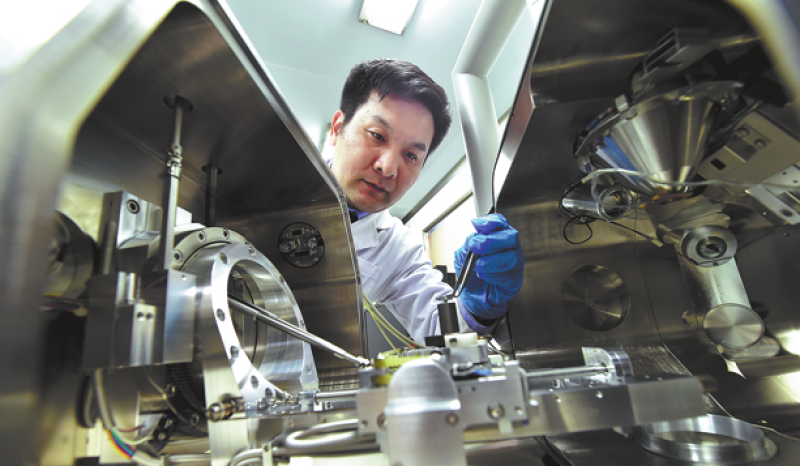
Ren Fei works at his laboratory in Taiyuan, Shanxi province. China Daily
In the world of forensic science, a small error can be the difference between justice and a cold case. For Ren Fei, a 46-year-old police officer in Taiyuan, Shanxi province, the laboratory is a battlefield where molecules are the primary witnesses.
Ren was recently honored as one of China's "most beautiful grassroots police officers" of 2025 by the Publicity Department of the Communist Party of China Central Committee and the Ministry of Public Security.
His 16-year career has redefined how the nation detects everything from toxic food to designer drugs.
Over the years, he has worked on more than 5,000 cases involving poisons, drugs and trace evidence. His contributions have extended beyond individual cases, as two of his research projects have become national standards for public safety.
Ren first gained national prominence by tackling "gutter oil" — the hazardous, recycled cooking waste that had long been a source of public anxiety.
While the refined sludge often looked like normal oil to the naked eye, Ren discovered that the spicy essence of Chinese cuisine provided a hidden fingerprint. By identifying capsaicin as a marker, he developed a detection method so sensitive it could find a single drop of the compound in an Olympic-sized swimming pool. This breakthrough eventually led to the creation of rapid test strips distributed nationwide for free, a move that earned him a gold medal at the national public security innovation competition in 2017.
The scope of Ren's work extends far beyond the kitchen. As the technical leader of a laboratory designated a national key forensic facility, he has pivoted toward the evolving landscape of narcotics.
Recognizing that psychedelic substances often metabolize too quickly for traditional blood tests to catch, Ren's team developed "version 3.0" rapid test strips that provide instant results at the source. This technology was instrumental in 2021 when Taiyuan police dismantled a massive "laughing gas" (nitrous oxide) syndicate, leading to over 100 arrests and the closure of several illegal storage sites.
"We aim to introduce more convenient testing devices in the future, allowing for quick and simple checks to ensure safety and mitigate risks at the source," Ren said.
Ren has also turned his attention to public health issues, such as illegal additives in health supplements and meat adulteration. He has led efforts to develop detection methods for over 400 illegal substances using advanced analytical instruments.
In 2024, the Taiyuan Public Security Bureau's physical and chemical laboratory, under Ren's technical leadership, was designated a key forensic laboratory by national authorities.
Recently, his team spent four months developing a method to authenticate liquor by analyzing over 100 aroma compounds in Chinese baijiu, aiming to trace counterfeit products back to their source.
Ren has evolved from a solitary "tech enthusiast" into a leader guiding a team of experts. He often reminds his colleagues, "In forensic science, a small error can lead to a significant deviation from the truth".
"Mastering a technique adds a new weapon against crime; creating a method provides a new strategy for victory; solving a problem uncovers a new way to expose wrongdoing," Ren said.
"I want to make detection technology faster and more accessible to protect people's lives, and inspire more young people to prepare for a safer China," he said.