Commercial rocket makes maiden flight
Launch sent experimental robotic cargo spaceship, satellites into orbit
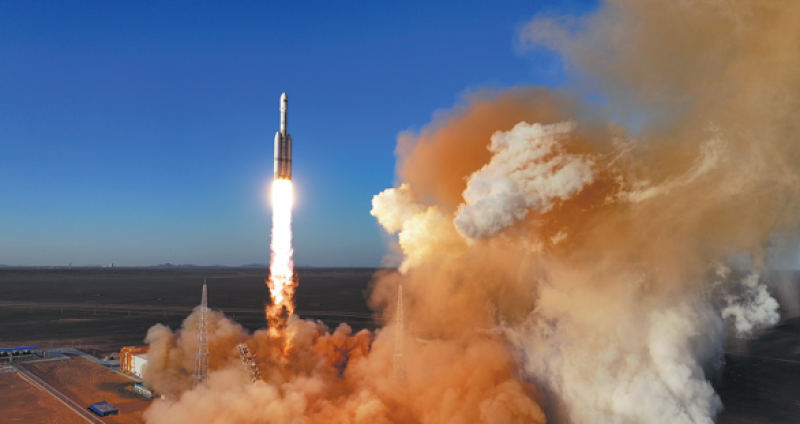
Kinetica 2, the new rocket model developed by Beijing-headquartered CAS Space, lifts off for its maiden flight from the Jiuquan Satellite Launch Center in northwestern China on Monday. WANG JIANGBO/FOR CHINA DAILY
A leading commercial space company conducted the debut flight of its new carrier rocket model on Monday, placing an experimental robotic cargo spaceship and two satellites into their designated orbits.
Kinetica 2, the new rocket model developed by Beijing-headquartered CAS Space, blasted off at 7 pm from the Jiuquan Satellite Launch Center in northwestern China, with flames shooting out of its nine first-stage engines and illuminating a vast expanse of the Gobi Desert.
After a short flight, the rocket reached outer space and deployed the New March 02 experimental spaceship, the New March 01 technology demonstration satellite and the TS 01 educational satellite into their preset orbital positions.
Designed and built by the Shanghai-based Innovation Academy for Microsatellites of the Chinese Academy of Sciences, the New March 02 is a single-section cargo vessel weighing 4.2 metric tons. It features new technologies and is capable of operating in orbit for three years.
Previously, the only cargo spaceship used by China was the Tianzhou, a larger model made by the China Academy of Space Technology. To date, nine Tianzhou vessels have been launched and eight of them have transported fuel and supplies to the Tiangong space station.
Yang Haoliang, project manager of Kinetica 2, said that the new rocket model will offer China's mission planners a fresh option when they prepare for cargo delivery to the Tiangong. "They now have at least two types of launch vehicles to send materials to the space station, and these two can act as backup for each other, which gives more flexibility to the cargo transportation system," he said.
Monday's launch was the 12th orbital mission completed by CAS Space, a company established by the Chinese Academy of Sciences. It also marked the first time a commercial rocket was used in China's manned space program.
The 53-meter-tall Kinetica 2 is a medium-lift, liquid-fuel rocket, and the second launch vehicle developed by CAS Space following Kinetica 1. It is the company's first liquid-propellant rocket, and is tasked with supporting China's large-scale satellite deployment and low-cost cargo transportation for the Chinese space station.
The rocket consists of a multistage core booster, which has a diameter of 3.35 meters, and two side boosters that are equally wide. Its liftoff weight is 625 tons, with a maximum thrust of 753 tons. The rocket is able to transport spacecraft with a combined weight of 8 tons to a typical sun-synchronous orbit at an altitude of 500 kilometers, or 12 tons to a low-Earth orbit 200 km above land.
A key feature of the rocket is its modular design, especially the common booster core configuration, in which the first-stage core booster and the two side boosters have the exact same module.
Kinetica 2 is the first Chinese rocket to adopt such a configuration. The model can either remove its two side boosters or add two more side boosters, thereby adjusting its carrying capacity to meet different mission requirements.
To save research time and operational costs, the Kinetica 2 uses flight-proven components from its predecessor, the Kinetica 1, and uses 10 identical engines as its power plant.
Attempts at recovery
Lian Jie, one of the deputy chief designers of Kinetica 2, said the rocket will make attempts to recover its first-stage core booster and the two side boosters in following flights.
"The three boosters will stick together during the whole flight, which means they will fly back as a whole unit. Such a design requires fewer parts on the boosters and allows for better aerodynamic performance, higher reliability and lower manufacturing cost," he said.
Yang, the project manager, said that CAS Space plans to build an annual production capacity of 20 Kinetica 2 rockets at its newly finished "super factory" in Shaoxing, Zhejiang province, and will continue to reduce the model's launch cost by reusing major components.
The current per kilogram launch cost of Kinetica 2 in nonrecoverable mode is roughly equivalent to that of the Falcon 9, a rocket made by United States-based private spaceflight company SpaceX.
Yang said that once the Kinetica 2 achieves reusability, its launch cost is expected to be half that of Falcon 9.
Lian, the deputy chief designer, said that CAS Space has developed a rocket upper stage called Kinastra 1, which is scheduled to make its maiden flight this year. In the future, it will be mounted atop the Kinetica 2 to extend the rocket family's extraterrestrial reach, he said.
"That will make us the first commercial space enterprise in China to be capable of transporting payloads to high-altitude orbits, such as a geosynchronous transfer orbit or even a lunar transfer orbit," he added.
The upper stage is an optional module for rockets. It operates after the rocket's core stage and strap-on boosters stop working and separate from the payloads, propelling the spacecraft on interplanetary trajectories, or into orbits higher than what could otherwise be reached using conventional boosters.