Lunar soil bears proof of organic matter
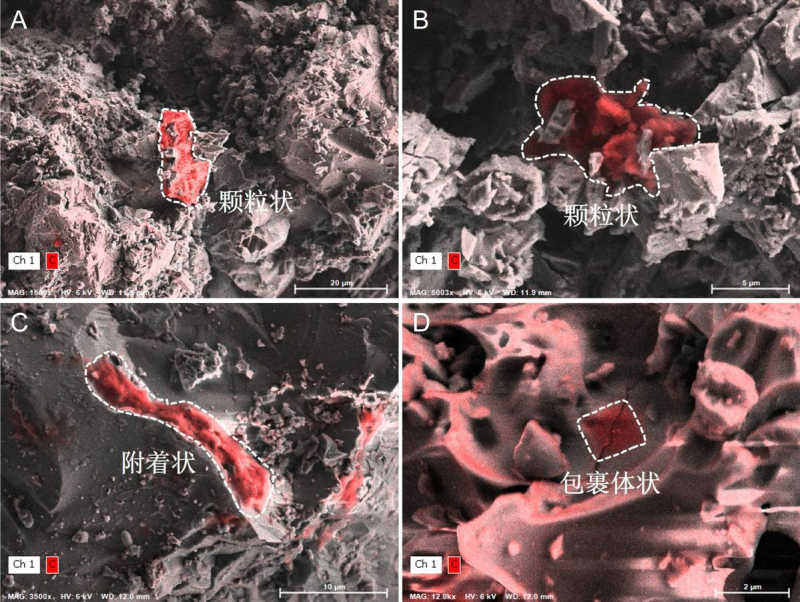
Representative organic matter is marked in microscopic images of lunar soil samples brought back by Chang'e 6 (top) and Chang'e 5 (bottom) missions. Photos provided to China Daily
An international research team has identified nitrogen-bearing organic compounds on the surface of moon soil for the first time, providing a new window into how the building blocks of life may have traveled through the early solar system.
By analyzing soil samples brought back by China's Chang'e 5 and Chang'e 6 missions, scientists from the Chinese Academy of Sciences, the University of New Mexico, and Changsha University of Science and Technology have mapped out how asteroids and comets likely delivered organic matter to the inner solar system. The findings, published on Thursday in the journal Science Advances, bridge a longstanding gap in our understanding of how the chemical precursors for life reached Earth.
While Earth's constant geological shifts and biological activity have wiped away much of its earliest history, the moon acts as a "time capsule". Because it has very little geological activity, it preserves evidence of space debris that crashed into it billions of years ago. Previous studies of samples from the United States' Apollo missions found organics containing carbon and hydrogen. However, scientists had not yet found nitrogen-bearing organics on the moon, even though they are common in asteroids like those sampled by NASA's OSIRIS-REx and Japan's Hayabusa2 missions.
This new study provides the missing evidence that shows organic materials are not only delivered by asteroid impacts but are also transformed by them. Using high-resolution microscopy and specialized light-based sensors, the team found that these organics are made of carbon, nitrogen, and oxygen. Unlike simple graphitized carbon, which is chemically inert or "dead", these materials show signs of complex reorganization.
Dong Mingtan, the study's lead author and a doctoral candidate at the Institute of Geology and Geophysics of the Chinese Academy of Sciences, said in some samples, the team identified amide functional groups. These are chemical structures essential to biological molecules like proteins. Dong noted that this indicates the materials have undergone a complex chemical reorganization, bringing their structure closer to organic molecules potentially usable by life.
The researchers also analyzed isotopes, which are different versions of chemical elements that act like a fingerprint. They found that the lunar organics were generally lighter than those found on asteroids. This signature aligns with a process of evaporation and redeposition. Essentially, the intense heat of an asteroid hitting the moon caused the organic molecules to vaporize and then settle back down onto the cold lunar soil.
To ensure the samples were not contaminated by material on Earth, the team looked for signs of solar wind implantation. This occurs when charged particles from the sun bombard the moon's surface over millions of years, leaving a distinct chemical mark.
Hao Jialong, a senior engineer at the institute and the study's corresponding author, said these features indicate prolonged exposure on the lunar surface and effectively rule out the possibility of terrestrial contamination.
The research identifies a full life cycle for lunar organic matter, moving from its delivery by small space bodies to its restructuring by impacts and its eventual modification by solar radiation. The team noted that this same analytical framework will be used to study samples from China's upcoming Tianwen 2 mission, which is expected to return asteroid samples to Earth by the end of 2027.