Weekly Advanced Technologies〔100〕

Weekly Advanced Technologies〔100〕丨Breakthrough in Observing Exotic Threshold Structures of Dipions; Liquid Metal-Based Protective Agents Show Progress in Organ Cryopreservation and Recovery
The strong interaction is a core research frontier in particle physics. The Beijing Spectrometer III (BESIII) experiment team conducted high-precision studies of charmonium decays and observed the double-pion threshold enhancement effect for the first time.
Transitioning from fundamental physics to biomedical challenges, the deep cryopreservation of complex organs has long faced difficulties such as inefficient heat transfer and thermal stress damage. A team from the Technical Institute of Physics and Chemistry, Chinese Academy of Sciences (TIPC, CAS) proposed a liquid metal cryoprotectant strategy. This approach achieves multi-scale enhanced heat transfer, enabling the deep cryopreservation of complex organs.
Based on the weekly diary of technology provided by the daily list of the NCSTI online service platform, we launch the column "Weekly Advanced Technologies" at the hotlist of sci-tech innovation. Today, let's check out No.100.
1. Physical Review Letters丨Breakthrough in Observing Exotic Threshold Structures of Dipions

Schematic Diagram of the ψ(3686) → π⁺π⁻J/ψ Decay (Legend)
A charmonium is a bound state composed of a charm quark and an anti-charm quark, serving as a "natural laboratory" for studying the strong interaction. The Beijing Spectrometer III (BESIII) international collaboration has observed a peculiar "threshold enhancement" structure at the double-pion mass threshold.
Based on approximately 2.7 billion ψ(3686) events collected by the BESIII detector, the research team screened out about 37 million ψ(3686) → π⁺π⁻J/ψ decay events and completed a high-precision analysis. The results show a clear peak-like structure near the π⁺π⁻ threshold in the pion pair mass distribution. The measured mass of this structure is approximately 285.6 ± 2.5 MeV/c², with a width of about 16.3 ± 0.9 MeV. Its width is significantly narrower than that of known pionium states. Comparative analysis using two theoretical models indicates that this structure is not a new particle in the conventional sense. It may be related to the internal structure and decay mechanism of the ψ(3686) particle itself, representing a quantum dynamical effect formed instantaneously during the decay process under the strong interaction.
This achievement provides a new observational window for understanding the complex behavior of the strong interaction in the low-energy non-perturbative region.
2. Matter丨Liquid Metal-Based Protective Agents Show Progress in Organ Cryopreservation and Recovery
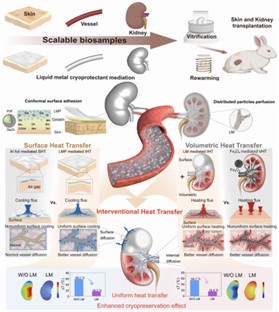
Organ Cryopreservation Method Based on Liquid Metal Cryoprotectants and Multi-scale Interventional Enhanced Heat Transfer
Cryopreservation is an effective method for long-term storage of biological materials. With the advancement of clinical medicine, regenerative medicine, and organ transplantation, the demand for preserving large-scale tissues and complex organs has increased significantly. However, biological samples inherently exhibit high thermal resistance and poor thermal conductivity, making efficient heat transfer difficult and often leading to fatal thermal stress damage.
A research team from the Technical Institute of Physics and Chemistry, Chinese Academy of Sciences (TIPC, CAS) has proposed a preservation method based on a liquid metal cryoprotectant. This cryoprotectant can be injected, perfused through vascular networks, or applied to tissue surfaces. It reduces the interfacial and contact thermal resistance of tissues and organs, increases the rewarming rate, and reduces thermal stress by two orders of magnitude.
This achievement provides a universal solution for the conformal cryopreservation of complex tissues and organs and could help alleviate the shortage of donor organs.
3. Global Change Biology丨Phosphorus Enrichment Reshapes the Global Terrestrial Ecosystem Phosphorus Cycle
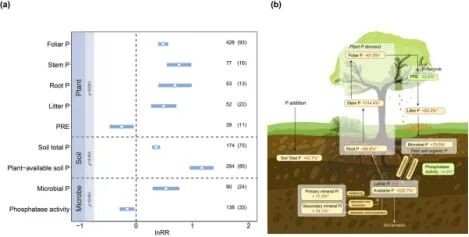
Overall Impact of Phosphorus Addition on the Terrestrial Ecosystem Phosphorus Cycle
Phosphorus is a critical element limiting plant growth and the productivity of terrestrial ecosystems. In recent decades, external phosphorus inputs to natural terrestrial ecosystems have significantly increased through atmospheric deposition and phosphorus fertilizer application, altering phosphorus availability.
Researchers from the Institute of Botany, Chinese Academy of Sciences, constructed a global database compiling 1,315 observations from 176 published studies, covering 159 natural terrestrial ecosystems worldwide. The study found that phosphorus addition significantly increases phosphorus concentrations in various plant tissues, litter, soil, and microorganisms. Concurrently, it reduces the phosphorus resorption efficiency of plant leaves and suppresses soil phosphatase activity, indicating a mitigation of ecosystem phosphorus limitation and a shift in phosphorus acquisition strategy from recycling to active uptake. Furthermore, the sensitivity of different phosphorus cycle components to phosphorus addition varies, with divergent responses across climatic zones. Some indicators in tropical regions exhibit higher sensitivity, a difference primarily regulated by background nutrient levels, climate, and fertilization regimes.
This research provides a reference for understanding phosphorus dynamics in terrestrial ecosystems and offers a theoretical foundation for predictions related to global change.
4. International Journal of Mechanical Sciences丨Progress in the Theoretical Study of Large Deformation of Spherical Shells under Multi-field Coupling
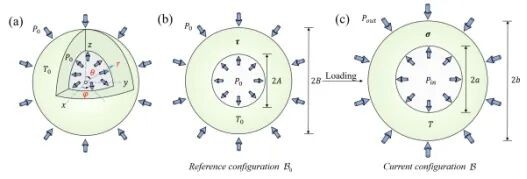
Schematic Diagram of Spherical Shell Deformation under Internal and External Pressure, Initial Stress, and Thermal Load
During the development of unconventional energy sources such as shale oil and gas, deep reservoir pores are subjected to the combined, long-term effects of in-situ stress, temperature variations, and internal/external pressures. Pore volume and stress states continuously evolve under these multi-field coupled conditions. Spherical pores serve as a commonly used idealized model for describing pore evolution in porous media, and the related large deformation problem of spherical shells is widely applicable in engineering scenarios such as pressure vessels and microcapsules.
Researchers from the Institute of Mechanics, Chinese Academy of Sciences, have derived an analytical solution for the thermo-mechanically coupled deformation of pressurized spherical shells with initial stress, based on invariant theory. This solution characterizes the coupled feedback relationship between temperature, pressure, and structural deformation of the shell. Validated through multi-dimensional comparisons with finite element simulations and experimental results on shale pore evolution, this theoretical solution accurately describes the evolution of shale pores under compression and thermal effects. Using this model, the team analyzed the mechanical responses under three typical working conditions, clarified the competitive mechanisms between thermal expansion and pressure constraints, and revealed the influence of initial stress on shell deformation, critical pressure thresholds, and stress distribution. The findings demonstrate that deformation and stress within the spherical shell can be controlled through parameter adjustments.
This research extends the classical theory of spherical shell expansion, providing a theoretical reference for the development of deep unconventional oil and gas resources and establishing a foundation for subsequent mechanical studies under complex geological conditions.