Weekly Advanced Technologies〔101〕
Based on the weekly diary of technology provided by the daily list of the NCSTI online service platform, we launch the column "Weekly Advanced Technologies" at the hotlist of sci-tech innovation. Today, let's check out No.101.
1. Scientists from Beihang University Develop Wearable Robot to Help Children with SMA Stand Independently
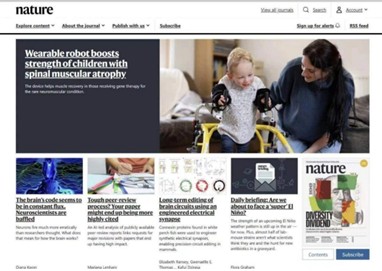
May 20 – An original research achievement by a team led by Feng Yanggang from Beihang University (BUAA), in collaboration with the Massachusetts Institute of Technology (MIT) and Peking University Third Hospital, has been published in the prestigious journal Nature. The study features a wearable robot weighing only 0.96 kilograms that can assist children with Type II Spinal Muscular Atrophy (SMA) in achieving independent standing.
SMA is a rare genetic disorder where a child's muscles gradually weaken and atrophy. Most affected individuals are unable to perform the sit-to-stand movement throughout their lives. Current medications can only slow disease progression, while traditional assistive robots mainly provide external force compensation. Conventional training equipment is often bulky and costly.
This novel robot employs the principle of isokinetic resistance training, which allows muscles to generate maximum tension throughout the entire range of joint motion. It is also equipped with a gamified interactive interface, enabling children to complete high-intensity training by playing through obstacle-clearing games. Clinical trials demonstrated that after six weeks of training, six children aged 6 to 10 achieved the milestone of transitioning from sitting to standing. Their quadriceps muscle strength improved significantly, showing enhanced neuromuscular coordination and development. Notably, the rehabilitation effects persisted even after the robot was removed.
2. Doubao App's AI Guide Offers Hands-Free Audio Tours in Museums

On the occasion of the 50th International Museum Day, ByteDance's AI chatbot application, Doubao App, officially launched its "Museum Guide" mode. Users can access this feature by tapping the "Museum Guide" button within the app, initiating a video-call-like interface. By pointing their device's camera at an exhibit, the system automatically recognizes the item and provides a detailed introduction. Upon voice command, such as saying "introduce each exhibit you see," the guide offers a continuous, hands-free audio tour as the visitor walks through the museum.
Online, the mode currently covers over 20 museums and cultural institutions, including the National Museum of China, the Capital Museum, and the Gansu Provincial Museum. Offline, Doubao has partnered with five museums to serve as an official AI guide for specific exhibitions, such as the Silk Road Civilization Exhibition, the Mancheng Han Tomb Artifacts Exhibition, and a Renaissance Masterpieces Exhibition. The feature also includes a "Family Mode" tailored for younger audiences.
The project lead for Doubao's museum initiative stated that the team will continue to deepen its engagement in the cultural and museum education sector. Through technological upgrades and expanded data collaborations, the aim is to further integrate technology with the humanities and arts.
3. Beijing's Robot Model Dominates 17 of 30 Tasks in Global Dexterity Benchmark
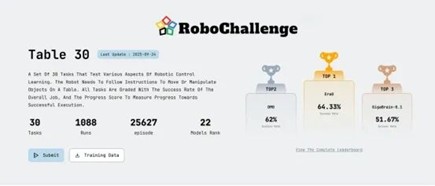
May 20 – The global embodied AI robot evaluation platform, RoboChallenge Table30, updated its leaderboard. The Era0 model from ROBTERA (Xingdong Jiyuan) ranked first with a comprehensive score of 76.34 points and a task success rate of 64.33%. It achieved the top score in 17 out of 30 tabletop dexterous manipulation tasks.
The benchmark evaluates both task completion and the quality of the manipulation process. Era0's leading performance stems from its deep integration of Vision-Language-Action (VLA) models with a World Model. It ranked first in key dimensions such as bimanual coordination, flexible object manipulation, and multi-view perception.
The ROBTERA team has consistently iterated its technology across three layers: data governance, model optimization, and engineering implementation. The company has previously won multiple international embodied AI competitions. Currently, ROBTERA's technology is deployed in logistics sorting scenarios, with partnerships including China Post and SF Express. Its systems are in regular operation at over ten logistics centers across five provinces in China.
4. Beijing Universities Among First to Offer New Embodied AI Degree

Recently, China's Ministry of Education updated the national undergraduate program directory, with nine universities becoming the first to establish the new "Embodied Intelligence" major. In Beijing, Beihang University (BUAA), Beijing Institute of Technology (BIT), and Beijing University of Posts and Telecommunications (BUPT) are among the pioneering institutions offering this program.
Beihang University integrates five first-level disciplines including Mechanical Engineering and Artificial Intelligence. The program is co-established by four schools and two research institutes, with practical training bases built in collaboration with companies like Huawei and DJI.
Beijing Institute of Technology leverages platforms such as the National Key Laboratory of Autonomous Intelligent Unmanned Systems. The program is led by a faculty team headed by Academician Zhang Jun and includes a joint AI practice laboratory established with Huawei.
Beijing University of Posts and Telecommunications places the Embodied Intelligence major within its Future School. It is enrolled under the "Yuan Class" of the Computer category, featuring an integrated undergraduate-postgraduate training model. The university has also launched an "AI Computing Power for All" initiative, providing first-year undergraduates with dedicated AI computing accounts.
All three universities focus on interdisciplinary training. Graduates are expected to pursue careers or further studies in fields such as artificial intelligence, robotics, and national defense.
5. Beijing Kicks Off Pilot Line for Flexible, Radiation-Tolerant Space Solar Cells
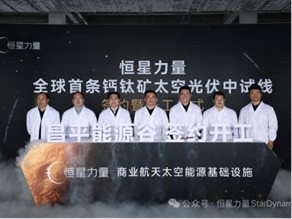
The world's first pilot production line for perovskite space photovoltaic cells has officially commenced construction at the Future StarTech Energy Valley Intelligent Manufacturing Industrial Park within Beijing's Future Science City. With a total investment of approximately 150 million yuan, the project is expected to be completed and operational by August 2026.
This pioneering project is developed by Beijing Stellar Power Technology Co., Ltd., leveraging technological achievements from the research team at Beijing Institute of Technology (BIT). Compared to the mainstream gallium arsenide (GaAs) solar cells currently used in space, the perovskite space photovoltaic cells offer significant advantages: they are over 50% lighter, cost about one-tenth as much, and can be produced in large areas using solution-based methods. These cells are designed to withstand extreme temperature fluctuations between -150°C and 150°C and high levels of radiation. They also maintain stable power generation under low-light conditions, and their flexible nature allows them to conform to the curved solar wings of satellites.
Future Science City aims to drive the application of perovskite technology by fostering an ecosystem for the advanced energy industry.
6. Published in Cell: Beijing's Team Develops Highly Accurate 'Biological Age Clock'
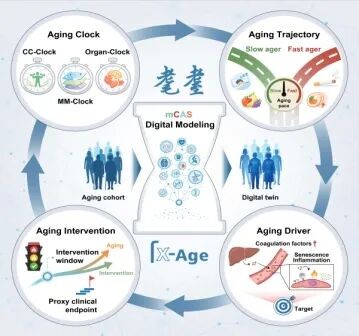
Recently, a research team from the Beijing Institute of Genomics, Chinese Academy of Sciences, in collaboration with multiple institutions, has constructed a digital holographic framework of the aging human body. This transforms aging from a qualitative description into a quantifiable and simulatable subject of research.
Based on data from healthy volunteers, the team collected over 240 physiological indicators to build a multimodal aging clock system. This system predicts an individual's biological age with an error margin of only 3.87 years. Simultaneously, the team constructed independent aging clocks for six major organs: the brain, liver, lungs, muscles, blood vessels, and skin.
The research revealed that the liver reaches its aging inflection point earlier than the brain. It also identified two key periods of accelerated aging: ages 40-50 and 60-70. The study pinpointed that the abnormal activation of blood coagulation pathways during the 60-70 age period is a core driver of accelerated aging.
The findings confirm that clotting factors produced by the liver are key molecules driving the aging of blood vessels and multiple organs. This achievement provides a methodology for assessing biological age and identifying prematurely aging organs through blood tests. The team is continuing to iterate the model and develop low-cost detection technology.