Laser weed cutter set to slash need for herbicides
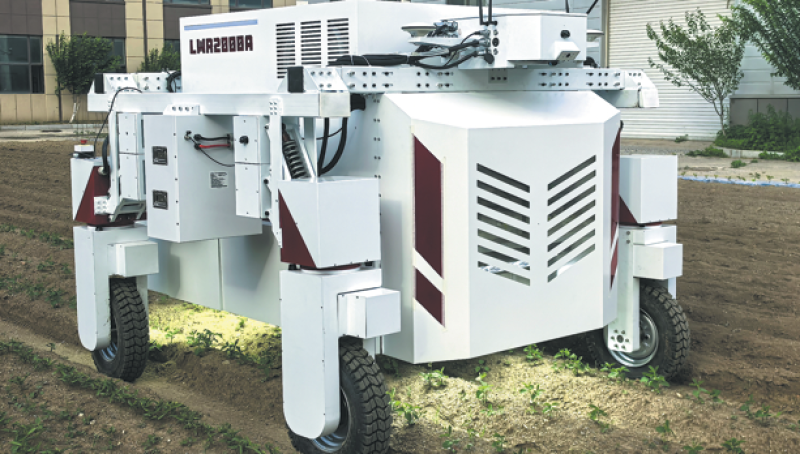
The fourth-generation intelligent laser weeding robot is tested in a field in Changchun, Jilin province. CHINA DAILY
In the race to modernize global agriculture, a team of Chinese scientists and engineers has recently developed a self-propelled, artificial intelligence-driven robot that blasts weeds with high-energy lasers in milliseconds, eliminating the need for chemical herbicides.
Developed through a 20-million-yuan ($2.94 million) collaboration between Changchun University of Science and Technology and Ningbo Yibin Electronic Technology, the fourth-generation intelligent laser weeding robot has completed its final field trials. It is scheduled to enter mass production by the end of this year.
"The robot utilizes laser technology, along with the capabilities of multipurpose unmanned ground vehicles, to accurately identify and locate weeds," said Wang Xiantao, a professor from the university and head of the research team. "High-energy laser units are used for precise weeding and navigation technology enables the machine to follow a reasonable path."
In 2023, the university formed a 10-member specialized R&D team, composed of experts in optics, mechanics, electronics and control. Chassis engineers were recruited from the company.
The team became the first in China to systematically develop laser weeding equipment.
"At that time, the Ministry of Agriculture and Rural Affairs listed laser weeding technology as a shortfall project in China's agricultural machinery, which relied on physical weeding," Wang said.
In November 2023, the team completed the first-generation prototype, establishing the basic principles of laser weeding.
In April 2024, they launched the second-generation towed field prototype equipped with eight laser units, completing data collection under various conditions in cornfields and verifying the feasibility of field operations.
By September of the same year, the third-generation independent unmanned prototype was developed, achieving real-time measurement of weed height in three dimensions, with dynamic positioning accuracy controlled within three millimeters.
In May 2025, the finalized fourth-generation pure electric self-propelled weeding robot completed a full chain of technological advancements, with comprehensive optimization of the optical path structure and the recognition control system.
The delay from AI recognition to laser striking has been reduced to less than 10 milliseconds, with weed positioning accuracy enabling precise targeting of weed meristems for physical ablation while the vehicle continues to move, Wang said.
"Based on AI visual recognition technology, it can instantly distinguish between crops and weeds," said Wang. "We have established data models for over 10 crops, including corn, soybeans and potatoes, with a crop recognition rate exceeding 99.5 percent."
The laser weed cutter can reach speeds of up to 3.6 kilometers per hour, adjusting adaptively based on weed density, he said. It can clear 50,000 to 100,000 weeds per hour, more than 50 times the efficiency of manual labor.
These technological achievements have led to the applications for seven national invention patents, four of which have already authorized, establishing a completely independent intellectual property portfolio.
Phasing out chemicals
The black soil in Northeast China — one of the world's four major black soil regions — is known as the "panda of arable land" due to its high nutrient content. However, long-term and extensive use of chemical herbicides has led to soil compaction and pesticide residue exceeding standards, while manual weeding is inefficient and traditional mechanical weeding can damage crops.
In the provinces of Heilongjiang, Jilin and Liaoning, and the eastern part of the Inner Mongolia autonomous region, the total corn planting area exceeds 15.33 million hectares, with an estimated equipment demand of 700,000 to 1.4 million units, Wang said. "Once the laser cutter is implemented, it will form a 100-billion-yuan smart agricultural machinery industry," he said.
The team plans to continue advancing laser weeding technology toward multi-sensor fusion, cloud platform intelligent management and cluster collaborative operations.