Chinese scientists set world record for solar cell efficiency
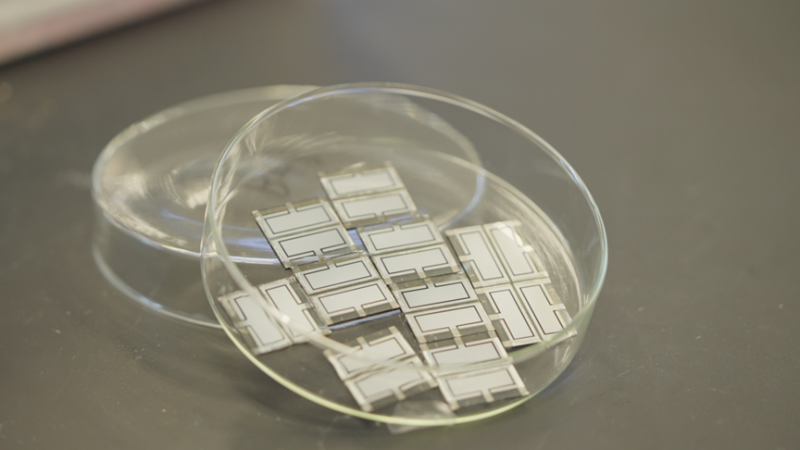
Chinese scientists develop new perovskite-organic tandem solar cells. (Provided to chinadaily.com.cn)
Chinese scientists have set a new world record for next-generation solar cells, bringing lightweight, flexible and highly efficient solar power closer to everyday use on everything from wearable devices to space stations.
The researchers achieved a certified steady-state power efficiency of 28.04 percent using a tandem solar cell. This double-layer design stacks two different solar-absorbing materials on top of each other to harvest significantly more energy from sunlight than traditional single-layer panels.
The study was published Monday in the journal Nature.
Unlike traditional silicon solar cells — which are rigid, heavy and require high-temperature manufacturing — these next-generation cells use a mix of "perovskite", a synthetic, highly customizable crystal structure, and organic materials. Because they are lightweight, flexible and can be printed at low temperatures like ink on paper, they promise a cheaper and easier route to mass manufacturing.
In a tandem solar cell, the top perovskite layer is customized to capture high-energy light like ultraviolet rays, while the organic bottom layer absorbs near-infrared light. The two materials work in tandem: the top layer blocks harsh ultraviolet rays that could damage the organic bottom layer, while the water-resistant organic layer protects the moisture-sensitive perovskite above it.
"This design allows scientists to 'tune' the material, essentially adjusting the specific colors of light it absorbs," said Meng Lei, a professor at the Institute of Chemistry of the Chinese Academy of Sciences and a corresponding author of the study.
Despite their promise, hybrid solar cells have long faced a major roadblock: internal chemical separation.
To absorb the right colors of light, the perovskite layer must be mixed with specific chemical salts called halides — specifically, iodine and bromine. However, these ingredients tend to separate. They fail to mix uniformly when the material is first cooling and crystallizing, and they separate again under prolonged exposure to sunlight during operation. This chemical separation creates microscopic defects, causing the solar cell to degrade rapidly.
To solve this, Meng's team created a smart, photo-transformable additive molecule called TDB.
TDB acts as a two-stage stabilizer. During manufacturing, it slows down the chemical reaction to ensure the ingredients mix perfectly as they crystallize. Then, once the solar panel is operating in the sun, the light itself triggers the TDB molecules at the material's microscopic boundaries to transform, binding tightly to the surface. This locks the ingredients in place and prevents defects from forming under sunlight.
"The light-transformable nature of TDB allows it to sequentially address challenges at two different stages," said Wu Ruihan, a doctoral candidate at the institute and the study's first author.
The results yielded a highly stable, high-performance cell. The optimized perovskite layer achieved an open-circuit voltage — a measure of its maximum electrical pressure — of 1.42 volts, a record for this class of solar cell.
When fully integrated into the double-layer tandem device, the technology hit a total power conversion efficiency of 28.80 percent, with a certified steady-state efficiency of 28.04 percent. Crucially, the device retained 90 percent of its initial performance after 625 hours of continuous illumination, proving that high efficiency does not have to come at the cost of durability.
Li Yongfang, an academician of the Chinese Academy of Sciences and a corresponding author of the study, said these ultra-lightweight, flexible cells could accelerate the global transition to clean energy.
Li noted that the technology holds strong potential for ground-level applications, such as solar panels integrated directly into building windows, wearable electronics, drones and portable power packs. It could also prove vital for aerospace applications, including powering satellites, space stations and deep-space missions.