China's lunar atlas to aid future exploration goals
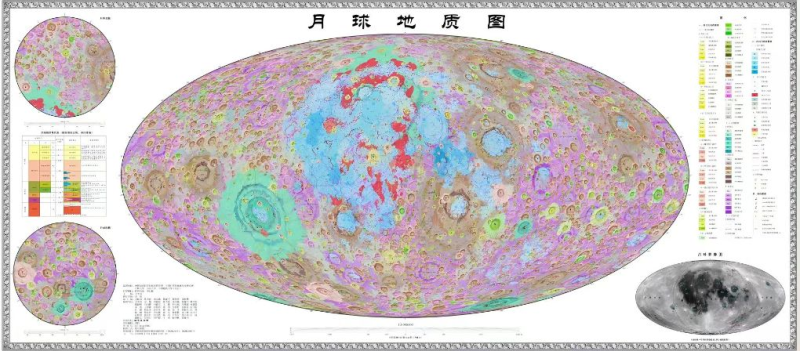
This image provided by the Institute of Geology, Chinese Academy of Geological Sciences shows the geologic map of the entire moon on a scale of 1:5 million. (Photo/Xinhua)
China has completed a geological map of the entire moon at a scale of 1:5,000,000, providing a comprehensive reference for lunar science research and future exploration missions.
Scientists at the Institute of Geology of the Chinese Academy of Geological Sciences led the compilation of the map using data from the Chang'e lunar exploration program. The map identifies more than 13,000 impact craters and 81 impact basins, while classifying 14 types of geological structures and 17 types of rocks across the lunar surface.
The main map measures about 280 centimeters long and 120 cm high and is accompanied by separate geological maps of the moon's north and south polar regions.
The project also improves scientists' understanding of the moon's geological history by refining its timeline of major events. Researchers revised the dating of the Aitkenian period — marked by the formation of the South Pole-Aitken Basin, the moon's largest known impact basin — to 4.33 billion years ago. They determined start dates of 4.17 billion years ago for the Nectarian period and 3.92 billion years ago for the Imbrian period. The study also produced the first global subdivision of the moon's later geological history, allowing scientists to better distinguish different stages of its evolution.
Researchers also updated the inventory of lunar rocks and minerals by using higher-resolution maps of mineral distribution and improved rock classification standards. The work was supported by findings from the Chang'e 4 and Chang'e 6 missions.
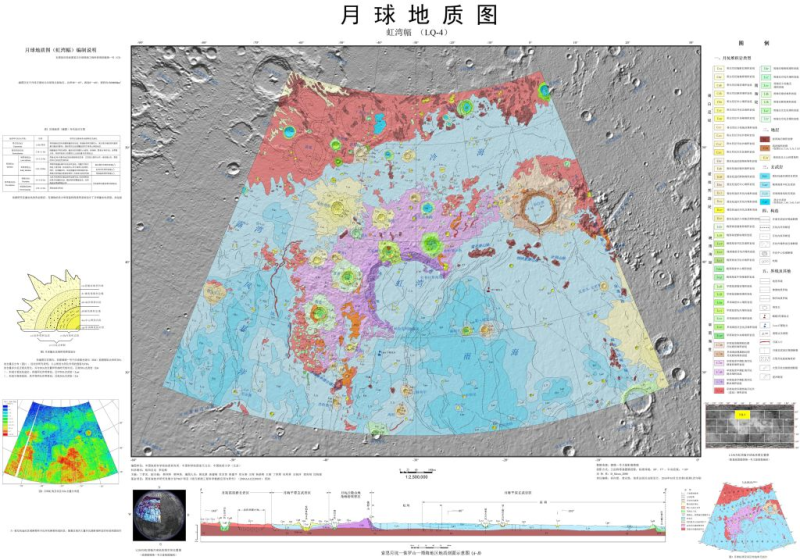
This image provided by the Institute of Geology, Chinese Academy of Geological Sciences shows an inset geologic map of the moon. (Photo/Xinhua)
Based on those samples, scientists identified a previously unrecognized rock type, known as gabbronorite, a dark, coarse-grained igneous rock formed deep underground in the South Pole-Aitken Basin. The discovery provides rare direct evidence of materials that originated deep beneath the moon's surface, offering new clues to its internal structure and evolution.
To improve both scientific accuracy and readability, the team also adopted varying mapping standards for different types of geological features. This approach preserves important details without making the large-format map overly complex.
Yang Zhiming, director of the institute, said the map will provide important scientific support for China's future lunar research station construction, landing site selection and deep-space exploration. Yang said that by leveraging AI technologies, the team plans to compile a new-generation 1:5,000,000-scale geological map of Mars to support the upcoming Tianwen 3 mission.