Weekly Advanced Technologies〔104〕
Based on the weekly diary of technology provided by the daily list of the NCSTI online service platform, we launch the column "Weekly Advanced Technologies" at the hotlist of sci-tech innovation. Today, let's check out No.104.
1. A Full-Duplex AI That Sees, Hears, and Chats in Real Time

On August 5, ByteDance officially launched the native audio-video full-duplex large model SeedRealtime, which is now fully available on the Doubao App. After updating, users can experience the feature through the "Voice Call" video call function.
In the past, AI audio and video processing relied on multi-module splicing, leading to high latency and frequent stuttering. This model adopts a unified architecture that integrates audio, video, and text, enabling simultaneous perception, reasoning, and response. It offers three key capabilities: audio-video linkage can identify multiple voices and visual scenes simultaneously, assisting in menu translation and explaining dish culture; it can actively track specified objects or mark segments; and in noisy environments, it can distinguish background noise from conversations. Tests show that the conversation stutter rate has been reduced by 50%.
This model is the first to achieve large-scale deployment of full-duplex audio and video capabilities. The team stated that it will continue to reduce interaction latency and strengthen adaptability in multi-person scenarios.
2. OR "Black Box" Guides Heart Surgery from 1,000 Miles Away
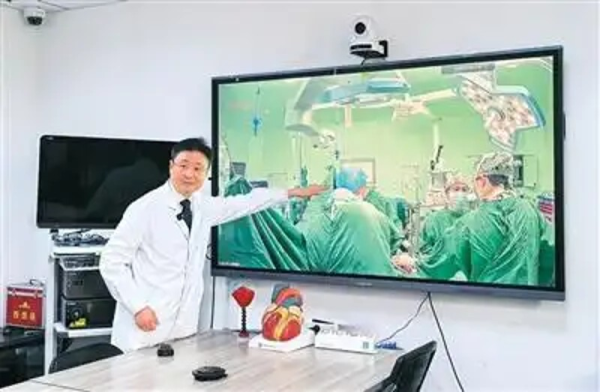
Recently, the surgical quality control robot MIRACQ, developed by Beijing Anzhen Hospital in collaboration with Beihang University and other institutions, successfully assisted in a remote surgery spanning 2,000 kilometers.
In the past, intraoperative imaging was often obstructed by medical staff or instruments, making it difficult to synchronize surgical footage with monitoring data. Traditional digital operating room renovations were costly, making it hard for grassroots hospitals to be fully equipped. The robot is easy to install and can be deployed within 3 minutes after powering on. The transmission delay is controlled to within 200 milliseconds, almost imperceptible to the human eye. It comes with an AI-powered tracking robotic arm that can actively avoid obstructions, and its 4K lens can capture blood vessels as small as millimeter-scale.
The device can centrally collect all data—including surgical field images, anesthesia parameters, ultrasound images, and vital signs—and archive them on a unified timeline. During this actual operation, experts in Beijing provided real-time remote guidance to a medical institution in Baoshan, Yunnan, successfully completing a mitral valve replacement surgery.
The device has now been deployed in multiple hospitals, accumulating over 25,000 complete surgical records. The research team plans to adapt it for orthopedics, general surgery, and other departments in the future.
3. AI Flight Control Algorithm Helps "Feiyan" Succeed in Maiden Flight

Recently, the domestically developed test aircraft "Feiyan" completed its full-subject maiden flight at a Hebei airport. Powered by a self-developed intelligent flight control algorithm, the aircraft autonomously performed test items including accelerated climb and high-angle maneuvering turns, with all data meeting the required standards.
The R&D team introduced deep reinforcement learning technology to build an integrated intelligent architecture encompassing perception, judgment, decision-making, and operation. The aircraft relies on onboard sensor data to autonomously adjust control surfaces and throttle. The team established a three-tier testing system: simple model simulation for logic validation, foam model low-altitude testing, and full-scale aircraft flight testing.
The test aircraft was jointly developed by the Beijing Institute of Mathematical Sciences and Applications and the COMAC Beijing Civil Aircraft Technology Research Center. The two institutions will jointly establish a laboratory focusing on research at the intersection of mathematics and aviation.