China's Long March 2D rocket launches four advanced radar satellites
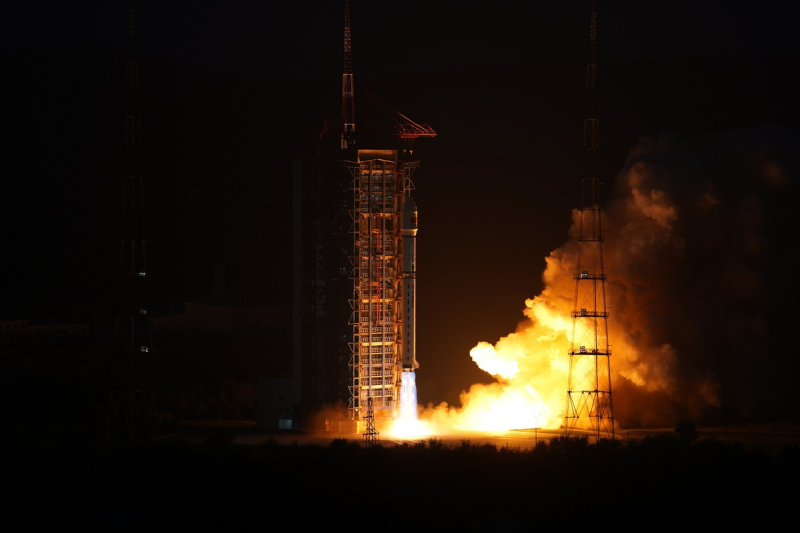
A Long March 2D carrier rocket blasts off at 6:50 pm from the Taiyuan Satellite Launch Center in North China's Shanxi province, Sept 19, 2026. (Photo/Xinhua)
China launched a Long March 2D carrier rocket on Saturday evening, deploying four radar satellites into space.
The rocket blasted off at 6:50 pm from the Taiyuan Satellite Launch Center in northern China's Shanxi province and later transported the PieSat-2 satellites to their preset orbit, according to GalaxySpace, a Beijing-based private company that built the satellites.
The satellites are equipped with high-resolution synthetic aperture radars and on-board intelligent processing and mission-planning payloads, which means they can make real-time in-orbit processing of remote-sensing data, the company said.
With this latest launch, GalaxySpace has successfully deployed 53 independently developed satellites, including more than 10 synthetic aperture radar satellites.
Duan Xiao, chief designer of GalaxySpace's radar satellites, said that multiple synthetic aperture radar satellites developed by the company have achieved large-scale in-orbit data processing.
Leveraging real-time on-board intelligent capabilities, the satellites can conduct data screening, preprocessing and information extraction, effectively reducing data backhaul pressure on satellite-ground links and significantly improving the processing efficiency of remote sensing data and request response speed, he said.
The Long March 2D rocket, made by the Shanghai Academy of Spaceflight Technology, is propelled by liquid propellants and has a liftoff thrust of 300 metric tons. It is capable of sending a 1.2-ton spacecraft to a sun-synchronous orbit with an altitude of 700 kilometers.
By now, China has conducted 69 space launches this year.