Pressure Unlocks Ising Superconductivity in Layered Material
A research team from the High Magnetic Field Laboratory of the Hefei Institutes of Physical Science of the Chinese Academy of Sciences, together with researchers from Shandong University and Anhui University, has discovered an unusual type of superconductivity in a layered material by combining organic intercalation with high pressure.
"Our findings show how changing the interactions between atomic layers can change a material's quantum behavior," said Prof. YANG Zhaorong. "They also offer a new way to explore unusual forms of superconductivity."
The results were published in Reports on Progress in Physics.
Layered materials often behave differently when their atomic layers are separated or squeezed together. However, studying these changes under extreme pressure can be difficult because ultrathin samples are usually fragile.
In this study, the researchers inserted an organic molecule between the layers of 1T-TaS2 crystals. This weakened the interaction between the layers, making the material behave more like a much thinner sample while remaining stable under high pressure.
The team then compared the intercalated material with ordinary 1T-TaS2 under high pressure. The two materials showed distinctly different routes to superconductivity.
In the original material, superconductivity emerged after a charge density wave state was suppressed. In the intercalated material, however, superconductivity appeared only at much higher pressures, after another electronic state had been suppressed.
The intercalated material also showed strong Ising characteristics in its superconducting state, making it unusually resistant to magnetic fields. Its upper critical field within the plane of the material exceeded twice the conventional Pauli limit.
The work offers a new way to explore quantum states in low-dimensional materials.
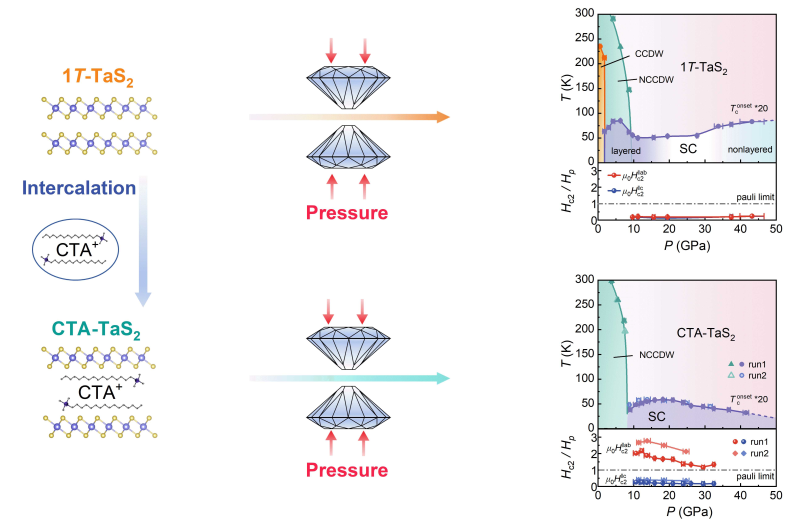
Schematic illustration of organic intercalation in 1T-TaS2 and its high-pressure phase diagram. (Image by CHEN Jiaqi)