Wild Boar Abundance Linked to Crop Damage and Higher Vertebrate Richness
Wild boars are considered one of the world's most problematic and invasive species outside their native range. Their populations are growing rapidly around the world due to their exceptional reproductive strategies and ecological adaptability. In China, mounting human-wild boar conflicts have prompted significant government investment in population control measures. However, culling based solely on perceived conflict may carry unintended ecological risks.
In a study published in Biological Conservation, researchers from the Xishuangbanna Tropical Botanical Garden (XTBG) of the Chinese Academy of Sciences demonstrated that, although wild boars are linked to increased crop damage, they may also play a crucial role in supporting biodiversity and ecosystem stability in tropical forests.
The researchers explored ways to balance mitigating human-wildlife conflict and maintaining ecosystem function in managing wild boar (Sus scrofa) populations. The researchers combined large-scale crop-damage records with camera-trap surveys at 540 sites in the tropical forests of Xishuangbanna. They focused on native medium- and large-sized terrestrial vertebrates. The researchers examined whether higher wild boar abundance was linked to greater crop damage, reduced habitat use by other vertebrates, and lower community richness or network stability.
Their results showed that areas with higher wild boar abundance experienced severe agricultural losses, particularly to maize. However, they also revealed unexpected ecological benefits. These areas supported greater species richness and more stable ecological networks. Wild boars appear to function as ecosystem engineers by creating microhabitats that benefit other species through rooting and wallowing.
The researchers also found that many species adjusted their activity patterns in space and time. As wild boar abundance increased, 21 out of 35 species showed greater divergence from wild boars in their diel activity patterns, and 23 out of 35 species exhibited temporary avoidance.
Therefore, culling based solely on conflict intensity may pose ecological risks, such as reducing local biodiversity and disrupting the stability of species coexistence networks.
"Relying solely on conflict intensity to guide population control decisions risks unintended ecological consequences. Our findings underscore the need to integrate ecological function assessments into management strategies," said QUAN Ruichang of XTBG.
The researchers are calling for a shift from "conflict-driven control" to evidence-based ecological management. Specifically, they recommend maintaining moderate-to-high densities of wild boars in core forest areas so they can continue performing their ecological engineering functions.
They also suggest using non-lethal preventive measures, such as fencing and repellents, along farmland edges. Additionally, they recommend establishing long-term monitoring systems so that management thresholds can be adjusted dynamically.
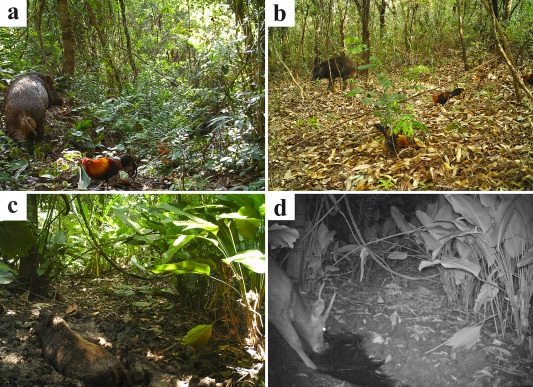
Camera-trap images illustrate potential facilitative interactions between sympatric vertebrates and wild boar.(Image by XTBG)