RoboMIND dataset surpasses 50 million downloads worldwide, expanding access to embodied AI
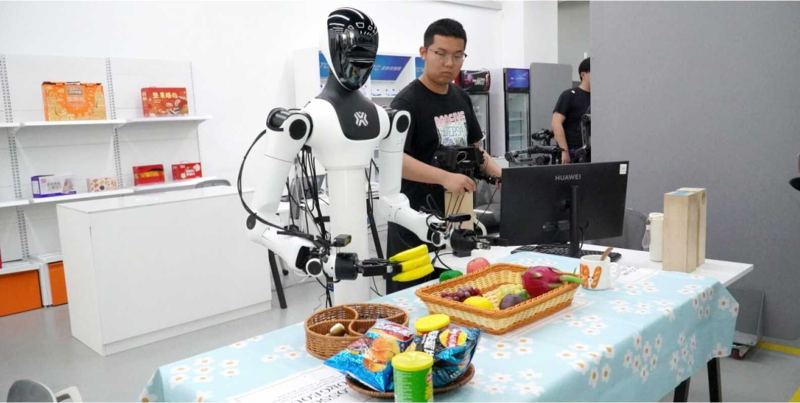
Photo/Convergence Media Center of Beijing E-Town
RoboMIND, an open-source robotics dataset developed by the Beijing Innovation Center of Humanoid Robotics, has surpassed 50 million cumulative downloads worldwide, making it one of the most widely downloaded and fastest-growing open-source datasets in embodied AI, according to the center.
The milestone reflects growing demand for high-quality robot interaction data as embodied AI moves from laboratory research toward real-world applications. RoboMIND provides developers with data for training robots to perform tasks ranging from grasping and moving objects to complex, fine-motor operations.
Four areas of global leadership
RoboMIND's capabilities extend beyond download numbers. It is the first open-source dataset to support coordinated dual-arm operation, mobile manipulation, dexterous hands and high-fidelity tactile sensing within a single framework. This allows developers to train robots on a connected sequence of actions, from picking up and transporting objects to carrying out precise manipulations.
It is also the world's largest publicly available robot-manipulation dataset collected using a unified approach across multiple robot embodiments. The dataset makes more than 400,000 dual-arm manipulation trajectories and over 700 practical tasks available to developers worldwide.
Its download growth has accelerated sharply. The dataset took 223 days to reach its first 10 million downloads, 39 days to reach the next 10 million, and just 18 days to add the fifth 10 million.
RoboMIND also offers broad coverage of different robot designs and objects found in real-world environments, with substantial variation in the range and granularity of the objects represented.
Three factors driving demand
A representative of the Beijing Innovation Center of Humanoid Robotics attributed the milestone to three factors: the expansion of the robotics industry, rising demand for data, and a reinforcing cycle between dataset quality and adoption.
First, the robotics community is growing as embodied AI moves beyond research laboratories into industrial development. More researchers, developers and industry professionals are entering the field, increasing demand for accessible technical resources.
Second, high-quality datasets have become essential infrastructure for AI development. Open-source datasets provide an accessible entry point for researchers and developers, while the growing number of people working in AI has increased demand for reliable training data.
Third, dataset adoption can generate a positive feedback loop. The quality of training data directly affects the performance of embodied AI applications. Drawing on the high-quality data supply of the center's data and training facility, RoboMIND attracts more users. Their use and feedback, in turn, help inform further improvements to the dataset.
From open-source data to a marketplace for robot skills
The center is extending this approach through its HuiSi KaiWu application store, which serves as a platform for sharing and deploying robot skills.
Rather than developing every capability from scratch, users can download existing skills much as they would download mobile applications, then deploy them to robots. The approach is designed to reduce the technical work required to bring robotic capabilities into practical use.
The platform also functions as an open marketplace for developers. Users can upload video footage to generate robot skills automatically or publish their own independently developed skills for others to access and share.
Together, the open-source dataset and application store are intended to lower the barriers to deploying embodied AI, shifting the process from writing code and building capabilities from the ground up toward downloading and applying existing solutions.
Looking ahead, the Beijing Innovation Center of Humanoid Robotics plans to work with more partners to jointly develop, share and research data. The aim is to address persistent challenges in data availability and robotic capabilities, helping more developers and companies move embodied AI applications from research into practical deployment.