Chinese designer shapes distinctive hotel experiences through design rooted in climate and place
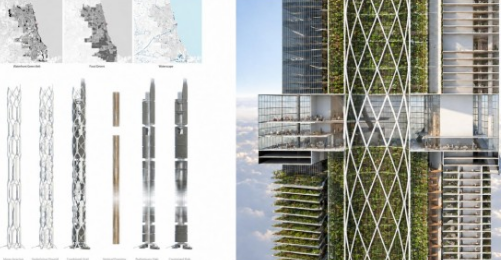
The section perspective view of the Eden Rise, designed by Chinese architectural designer Yuhan Zhang in collaboration with Dreama Simeng Lin, won the A' Design Award Silver in 2025. (Photo provided to chinadaily.com.cn)
The United States-based Chinese architectural designer Yuhan Zhang has keenly sensed a fast-evolving trend in the global high-end hotel and serviced-residence development sector: it is shifting from a pure pursuit of luxurious hardware toward an integrated model focusing on climate adaptation, local empowerment, and a premium experience.
He embeds climate conditions and site topography deeply into architectural schemes, translating climate and site research into design strategies that reduce long-term energy and operational costs while shaping hotel experiences with a distinctive sense of place.
Drawing on an interdisciplinary background in environmental science, Zhang led key design work on multiple international ultra-luxury mixed-use hotel projects — including Aman Seoul and The Dallas EDITION — while working at SCDA's New York office. Before joining the firm, he earned a bachelor's degree in environmental science from the University of California, Berkeley, and a Master of Architecture from Yale University.
"In today's global high-end hospitality investment market, developers face rising energy costs and increasing ESG (environmental, social and governance) compliance pressure, while high-net-worth consumers are willing to pay a premium for localized, nature-immersive experiences," Zhang said.
"The design value of a high-end hotel is reflected not only in the spatial quality at completion, but also in its use and operation over the following decades," he added.
For Zhang, climate and place are the starting point of design. Introducing wind environment, solar, and site analysis early in the schematic phase, and translating natural conditions into the basis for architectural form, spatial layout, and energy strategy — shaping distinctive hotel experiences while reducing long-term energy and operational costs.
Making a hotel respond to its location's environment and remain comfortable and vibrant through long-term use is precisely the design direction he continues to explore.
Tourism Management observations show that landscape and sense of place have become important components of high-end hotel asset value, and that quality landscape resources can command a certain room-rate premium. Meanwhile, optimizing building envelopes, daylighting and ventilation, and renewable energy layouts through early-stage climate simulation can reduce a hotel's whole-life-cycle energy expenses and enhance the property's long-term value retention.
Unlike traditional hotel design, which prioritizes aesthetics and floor-plan functionality, Zhang takes a holistic approach, bringing architecture, landscape, interiors, and the character of each location into a cohesive guest experience. His designs create a distinctive sense of place while supporting the project's commercial objectives.
Aman Seoul is Aman Group's first integrated project in South Korea — a large complex comprising a hotel, private residences, and an Aman Club. Shinsegae and OKO Group have announced plans for an initial $500 million investment in a joint venture covering a broader program of hotel and residential developments. Zhang led key aspects of the tower massing, facade development, sky gardens, and residential layouts.
At The Dallas EDITION Hotel and Residences in Uptown Dallas, Zhang led SCDA's landscape architecture design during the schematic design phase. He coordinated a multidisciplinary team to extend the landscape architecture scheme into an elevated outdoor plan, integrating landscape architecture into the experience of hotel guests and residents. The domestic project under construction — Chengdu La Cadiere Garden City — applies the same approach. Zhang led key aspects of the architectural design for the development's Hyatt Regency hotel, working closely with the client and interior design team.
For resort hotels, climate and site conditions have an even more pronounced impact on investment returns. The proposed Soori Wyoming project — adjacent to Yellowstone National Park and situated at the mouth of Clarks Fork Canyon in Wyoming — is an example. Through early-stage simulation-based design, Zhang led the project to both avoid the negative effects of strong winds on the building's usability and maximize photovoltaic output.
Beyond commercial projects, Zhang has also pursued independent research and design with Dreama Simeng Lin. Their collaborative Eden Rise proposal focuses on Chicago's lakefront, building a vertical community that integrates food production and renewable energy. It won the Silver Award in the Futuristic Design category at the 2025 A' Design Award. An earlier project, Sky Droplet, won Gold awards at the 2024 MUSE Design Awards and NY Architectural Design Awards, continuing to explore sustainable living models in high-density cities. Zhang also collaborated with Jiaming Gu on Inlet / Let-in, a master planning proposal addressing flood resilience and ecological restoration along New York's Harlem River. The scheme received a Silver award at the 2024 MUSE Design Awards and Silver awards in two categories at the 2024 NY Architectural Design Awards.