Study Links Clinical Characteristics to Brain Network Connectivity in Disorders of Consciousness
Predicting recovery for patients with disorders of consciousness (DoC) is exceptionally difficult due to the vast differences in injury causes and demographic backgrounds.
In a new study published a study in The Innovation Life on October 20, researchers from the Institute of Biophysics of the Chinese Academy of Sciences, Beijing Tiantan Hospital, and Capital Medical University have revealed the connection between clinical characteristics (e.g., etiology, age, and time since injury) and brain network connectivity. These characteristics play a crucial role in patients' functional recovery.
Clinical assessment results showed that patients with traumatic brain injury (TBI) exhibited higher consciousness levels and better long-term functional recovery than patients with anoxic brain injury. Additionally, younger age was associated with higher consciousness levels and better recovery outcomes. Among the patients included in this study who were at least 28 days post-injury, the time since injury showed no significant correlation with either of these two indicators.
To investigate the neural basis of these differences, the researchers analyzed resting-state functional magnetic resonance imaging (rs-fMRI) data from 128 patients with disorders of consciousness (DoC) and 40 healthy controls. They examined the functional connectivity among 22 cortical regions across six major brain networks, including the default mode network (DMN).
Integrating rs-fMRI with clinical assessments revealed that different clinical characteristics correspond to distinct brain network connectivity patterns. Specifically, etiology-related internetwork connectivity was closely associated with functional recovery.
Functional connectivity associated with etiology, age, and time since injury was distributed across different brain networks with minimal overlap. In a machine learning model designed to distinguish the three etiologies, the connectivity features of the DMN contributed the most.
Further analysis revealed that, compared to non-recovered patients, functionally recovered patients exhibited stronger positive intranetwork correlations and more pronounced negative internetwork correlations among etiology-related connections. These findings suggest that preserving modular network organization may be linked to recovery potential.
Statistical mediation analysis showed that internetwork functional connectivity could statistically explain the recovery advantage observed in patients with TBI compared to patients with anoxic injuries. However, age and time since injury did not demonstrate similar significant indirect effects.
These findings link etiology-related brain network connectivity to long-term functional recovery, offering insights into the varying recovery trajectories among patients with different etiologies.
Notably, the aforementioned mediation effects reflect statistical correlations rather than causal relationships. Therefore, further verification through longitudinal studies and interventional trials is necessary.
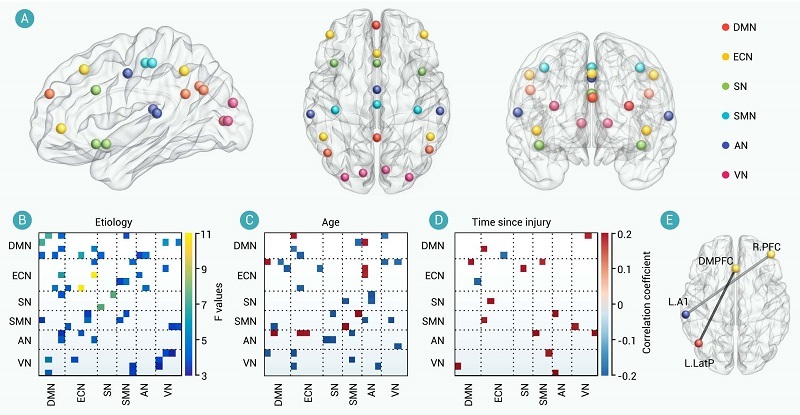
Relationship between brain network connectivity and clinical characteristics (Image by YANG Yan's group)