Draft AI export rules seek secure, open tech trade
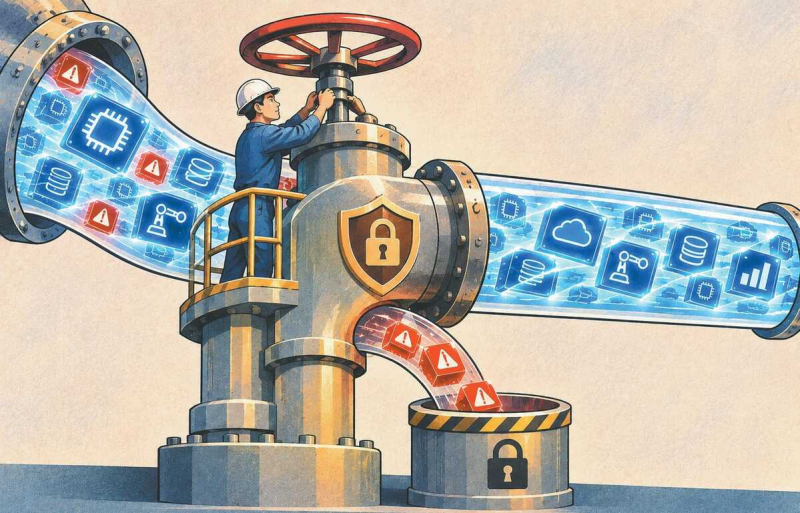
AI/CAI MENG/CHINA DAILY
As global competition in artificial intelligence increasingly becomes a central element of strategic rivalry among major powers, rules governing cross-border technology transfers are playing a critical role in shaping the international tech landscape.
Against such a backdrop, the Ministry of Commerce and the Ministry of Science and Technology jointly released draft revisions to the Catalogue of Technologies Prohibited and Restricted from Export for public comment in mid-October, proposing targeted adjustments covering advanced AI technologies.
The draft revisions cover 40 technologies related to AI, biomedicine and photovoltaics, proposing to prohibit the export of 14 technologies and restrict another 26, alongside automatic licensing and other facilitation measures in specified cases and situations.
This move reflects China's efforts to balance national security and tech self-reliance with high-level opening-up and international cooperation, while establishing clearer boundaries for the overseas transfer of sensitive technologies.
Formulated in accordance with the Foreign Trade Law and other regulations, the catalogue prohibits the export of tech classified as banned, and requires licenses for restricted tech.
Technologies outside these categories may be exported freely, subject to contractual registration requirements.
The adjustments come amid intensifying technological competition between China and the United States, particularly in AI, where restrictions on advanced chips, tech and related equipment have become important instruments of international competition.
Amid these developments, China is seeking to establish more precise, rules-based tech export controls to protect its competitive advantages in large AI models, autonomous agents and computing tech, while maintaining a predictable environment for international tech trade.
The revisions also reflect growing concerns over the security implications of increasingly powerful AI systems.
Advances in general-purpose models and autonomous agents have created new challenges for global cybersecurity, particularly as these systems acquire more sophisticated reasoning, decision-making and vulnerability-detection capabilities.
The Claude Mythos Preview model introduced by US AI company Anthropic in the first half demonstrates such risks. Although not designed specifically as a cybersecurity tool, its advanced reasoning and autonomous capabilities enable it to identify previously undetected software vulnerabilities, including a security flaw that had remained hidden for 27 years, according to the company.
Such developments highlight the potential threats that highly capable AI systems could pose to cybersecurity, critical infrastructure and national security if misused.
Uncontrolled open-source releases of technologies capable of supporting sophisticated cyberattacks could further increase these risks, underscoring the need for appropriate safeguards governing their cross-border dissemination.
China's approach therefore seeks to incorporate open-source releases into technology export management, while distinguishing between ordinary technological innovation and highly sensitive capabilities.
Under the proposed arrangements, technologies classified as prohibited — including certain AI-driven cyberattack tech — would generally not be eligible for open-source release, while restricted technologies could benefit from facilitated licensing procedures.
At the same time, the proposed framework seeks to avoid tech decoupling by allowing legitimate international cooperation and supporting the overseas expansion of Chinese AI companies within established regulatory parameters.
A central feature of the adjustments is a more differentiated approach to managing advanced AI technologies, covering large models, autonomous agents, computing infrastructure and information processing capabilities.
For large AI models, the proposed framework distinguishes between systems trained on core or important data, and those developed using ordinary commercial information.
Models trained on sensitive data may retain information about industrial technologies and production processes, as well as trade secrets and other information relevant to national industrial security.
Their uncontrolled transfer overseas could expose critical technological knowledge and undermine domestic industrial competitiveness.
By contrast, general-purpose models trained on ordinary commercial data would not face additional restrictions solely because they use AI tech.
For autonomous AI agents, the proposed approach combines technical capabilities with application scenarios, system architecture and access to external tools.
Prohibited categories would focus on high-performance agents operating in particularly sensitive areas, including critical infrastructure, national defense and core government functions.
Restricted categories would address capabilities involving multi-agent coordination, system architecture and tool use.
Reference indicators under consideration include exceptionally large computational workloads, model sizes exceeding two trillion parameters and performance approaching the global technological frontier or ranking highly in authoritative evaluations.
These indicators are intended to support differentiated assessments rather than determine regulatory classifications through a single technical threshold.
Another area of focus is the underlying tech supporting AI computing centers, particularly heterogeneous inference clusters, domestically developed computing-resource scheduling systems, server architecture and chip-system optimization.
Such technologies are important for China's tech self-reliance and the development of advanced AI capabilities.
At the same time, international cooperation involving these technologies could continue under appropriate licensing arrangements, allowing Chinese companies to provide sustainable tech solutions to overseas partners.
The adjustments also address advanced information processing technologies, including high-performance detection, information confrontation, voiceprint recognition and language translation.
Tech associated with cyberattacks and information confrontation would face particularly strict controls, reflecting concerns about the potential misuse of increasingly powerful AI systems.
Beyond security considerations, the revisions seek to accommodate the distinctive characteristics of open-source innovation.
Technologies that have already entered the public domain through open-source releases or academic publications would fall outside the scope of export management under the proposed framework.
For restricted technologies intended for open-source release, the proposed framework would provide facilitated procedures — including automatic licensing — to reduce administrative burdens and accommodate the rapid pace of tech development.
The proposed administrative arrangements also include project-based processing and advance submissions, enabling regulators to respond more quickly to firms seeking export approval.
These proposed measures aim to preserve the vitality of China's open-source ecosystem while maintaining safeguards against the uncontrolled dissemination of sensitive technologies.
The catalogue focuses on the export of underlying tech rather than the overseas sale of products and services.
Chinese companies may continue participating in offshore markets through application programming interfaces, software-as-a-service platforms, AI applications, industry solutions and integrated hardware-software products, provided their activities do not involve the substantive transfer of controlled technologies.
Such controlled tech may include restricted model weights, sensitive training data, source code, critical algorithmic documentation, computing-system designs and underlying implementations of highly sensitive autonomous agents.
This distinction is intended to protect China's advanced AI capabilities and critical industrial knowledge without unnecessarily impeding legitimate international commercial activities.
More broadly, the proposed revisions represent an effort to balance technological development and national security while maintaining China's commitment to high-level opening-up and international cooperation.
By combining differentiated controls with licensing facilitation and clearer regulatory boundaries, the framework seeks to safeguard sensitive technologies, support domestic innovation and preserve opportunities for overseas commercial expansion.
If adopted, the proposed arrangements will need to strike a careful balance between protecting critical tech capabilities and enabling international cooperation.
The ultimate objective is to support the high-quality development of China's AI industry, consolidate its advantages in large models, autonomous agents and computing infrastructure, and contribute to a secure, open, inclusive and mutually beneficial AI ecosystem worldwide.
The writer is a professor and deputy dean of the School of Law at the University of International Business and Economics in Beijing.