Green electricity among offerings from CGN
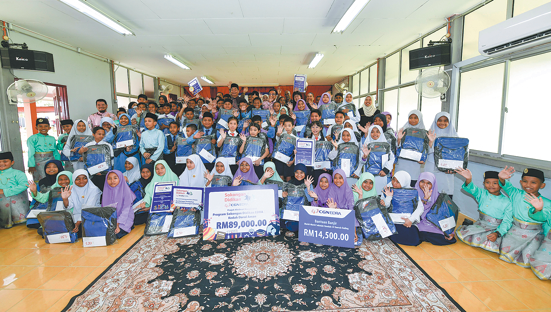
China General Nuclear Power Group's Edra Scholarship provides financial aid for Malaysian students in 2025. CHINA DAILY
China General Nuclear Power Group is delivering 100 percent green electricity to the main venue for the 33rd Asia-Pacific Economic Cooperation Economic Leaders' Meeting to achieve zero-carbon power consumption. With clean energy as its bond, CGN is promoting the energy transition and shared prosperity in the Asia-Pacific region.
The company's self-developed pole-mounted radioactive material monitoring system is also being deployed on pedestrian routes at the venue, allowing contactless passage while providing rapid warning and interception of anomalies.
Over the past four decades, the Shenzhen-based company has clean-energy projects across 21 countries and regions. It is now seeking to deepen its role in the Asia-Pacific energy transition through offshore wind, gas-fired power, nuclear power and solar projects.
The green power for the APEC venue comes from CGN's 400-megawatt Nanpeng Islands offshore wind farm in western Guangdong, which features 73 turbines. Its adjacent 2,000-MW Yangjiang Fanshi offshore wind project was connected to the power grid two months ago. It is China's first large-scale deployment of 18-MW ultra-large offshore wind turbines, with each turbine capable of generating 56 million kilowatt-hours of electricity annually.
CGN's offshore wind capacity in Guangdong province has hit 6,000 MW. This includes the 1,000-MW-class offshore wind base closest to Shenzhen and the first gigawatt-level offshore wind project in the Guangdong-Hong Kong-Macao Greater Bay Area. Power generated here is fed into the core grid of the GBA.
Founded four decades ago in Shenzhen's Dapeng Bay, CGN built the Daya Bay Nuclear Power Plant, China's first large-scale commercial nuclear facility, through international collaboration. The plant has long supplied roughly 25 percent of electricity needs of China's Hong Kong.
In Malaysia, CGN developed the Edra EMPP gas-fired power plant on the Strait of Malacca. At 2,242 MW, it is Malaysia's largest power plant. Equipped with the most advanced H-class gas turbine technology, the facility meets around 11 percent of Peninsular Malaysia's power demand and was honored as "Global Best Gas Power Plant" by POWER Magazine in 2023.
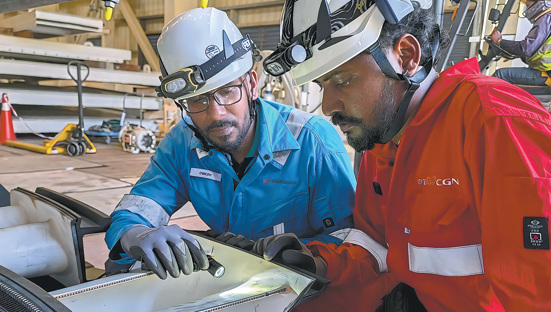
Two engineers of CGN Edra Energy check equipment in August. CHINA DAILY
CGN has invested in five power plants across Malaysia with a combined capacity of 5,077 MW, making it the country's second-largest independent power producer. These plants can power 2 million Malaysian households. They have delivered over 200 billion kilowatt-hours to local grids and cut emissions by an amount equivalent to planting 180,000 hectares of forest.
Completed in June, a gas turbine skills training center built to Chinese standards at EMPP is the first of its kind in Malaysia. CGN operates the largest overseas gas-fired power capacity among Chinese companies, with gas turbine projects in Malaysia, the United Arab Emirates, Pakistan and other countries. It has built an international gas turbine operation and maintenance workforce of nearly 1,000 professionals.
In November, CGN hosted a gas turbine power generation conference in Shenzhen and Malacca, bringing together more than 60 organizations and releasing a partner action plan. The plan sets out to build an integrated platform for joint technology creation, digital development, practical learning, talent cultivation, supply chain stabilization and ecosystem building. CGN describes it as the first cross-border gas turbine industry-academia-research-application partnership ecosystem.
In Malaysia's energy development, CGN has partnered with over 800 local suppliers, creating an ecosystem that opens up new opportunities for local businesses.
In Selangor, Malaysia, CGN is constructing a 300-MW floating solar farm on an abandoned mining pit. Once finished, it will be Malaysia's largest single floating solar installation and supply clean energy to 150,000 households. Built without occupying farmland or construction land, the project offers a replicable model for land-scarce regions.
"This kind of cooperation delivers mutual benefits. Chinese companies gain a development platform in Malaysia, while Malaysia gains access to technology, talent and job opportunities," Malaysian Deputy Prime Minister Fadillah Yusof said of the two countries' energy cooperation.
In Thailand's Rayong province, a CGN-built commercial electron-beam irradiation sterilization project, Thailand's first, is providing hygiene protection for medical supplies and food.
The company is also ensuring that the benefits of development reach local people. Malaysian engineer Wan Afif said in September that CGN's Edra Scholarship covered his tuition and living expenses for three semesters and helped him graduate. He joined the company in 2024 and now works as an engineer and grid interconnection inspector for a local solar project.
"CGN's support came from not only recognition and trust, but also a real entry ticket into the energy industry," Wan said.
The Edra Scholarship Program has expanded from six pilot schools in Malacca to 26 schools across four Malaysian states, benefiting more than 30,000 students. Dozens of graduates have joined the company after finishing their studies.
In Kedah, Malaysia, CGN launched a pilot agrivoltaics program by providing nearby villagers with free land to grow pineapples beneath and around the solar panels, combining energy production with agriculture. The project covers more than 90 mu (6 hectares), generating nearly 12,000 yuan ($1,800) in income per mu each year.
Khalid, a 65-year-old farm manager, said he hopes to expand planting to create more jobs and raise incomes for villagers.