Bridging the divide: how education and AI can build a shared future
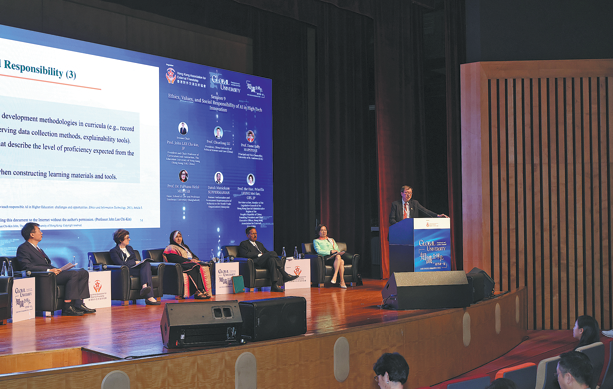
John Lee Chi-kin, president of EdUHK, chairs a high-level session entitled "Ethics, Values and Social Responsibility of AI in High-Tech Innovation" at the Global University Presidents and Leaders Summit 2026 in Hong Kong on Oct 27-28. CHINA DAILY
As China hosts APEC 2026 under the theme "Building an Asia-Pacific Community to Prosper Together", the forum is focusing on three pillars: openness, innovation and cooperation. Cutting across these priorities are the transformative force of artificial intelligence and the urgent question of how to harness it to close — rather than deepen — the divides in learning, information and economic opportunities.
The same challenge emerged at the recent 2026 Global South Modernization Forum in Cairo, Egypt, where participants called for the effective use of AI.
While governments play a critical role in narrowing this gap through policies and infrastructure investment, academia, the technology sector and the business community must also collaborate to dismantle barriers to accessibility and promote responsible, ethical adoption. Only then can AI drive productivity, innovation and human development across societies.
Education is central to this mission. Hong Kong, as a city where East meets West, combines the strengths of world-class universities, national guidance and support, global investment, and high-caliber talent. Backed by the Chinese mainland and closely connected to the Association of Southeast Asian Nations, or ASEAN, and countries involved in the Belt and Road Initiative, it serves as a vital bridge in advancing equitable digital transformation.
Ranked within the top seven globally in education by QS and other major league tables, The Education University of Hong Kong, or EdUHK, exemplifies this role. Through its leadership in teacher education, lifelong learning and digital transformation, EdUHK promotes professional development and regional capacity-building. Since serving as a core consultant for World Bank education initiatives in Vietnam in 2017, the university has continued to foster academic exchange, talent development and policy dialogue in places like Kazakhstan, the United Arab Emirates and ASEAN countries to help learners and institutions adapt to the digital era.
Leveraging its Global Research Institute for Finnish, European and Global South Education, for example, EdUHK has studied and compared Finland's renowned active-learning models with Chinese educational approaches, generating insights that combine the best of both. In recent years, the university has integrated AI into its education majors, faculties and curricula to cultivate critical thinking, problem-solving and ethical decision-making. Through joint research partnerships, academic exchanges and thought leadership, EdUHK has shared its experience and research findings with the Global South, the Middle East and Belt and Road countries such as Brunei, Cambodia and Indonesia. These efforts have inspired new approaches and broadened opportunities for future generations.
Just as the internet did a generation ago, AI presents a dual reality of immense opportunity and systemic risk. To achieve a truly equitable global society, hardware deployment and talent development must be paired with international educational diplomacy based on multilateralism and mutual cultural respect. By fostering an open, cooperative framework for knowledge transfer and mutual learning, global leaders can ensure that the next technological wave benefits every community, fulfilling the promise of a prosperous and inclusive Asia-Pacific.
The author is president of The Education University of Hong Kong. The views expressed are personal to the author and do not necessarily reflect the views of EdUHK, nor do they commit the university in any way.