Humanoid robot automates high-risk pressure gauge testing, enabling 24/7 operation
Photo/Beijing Innovation Center of Humanoid Robotics
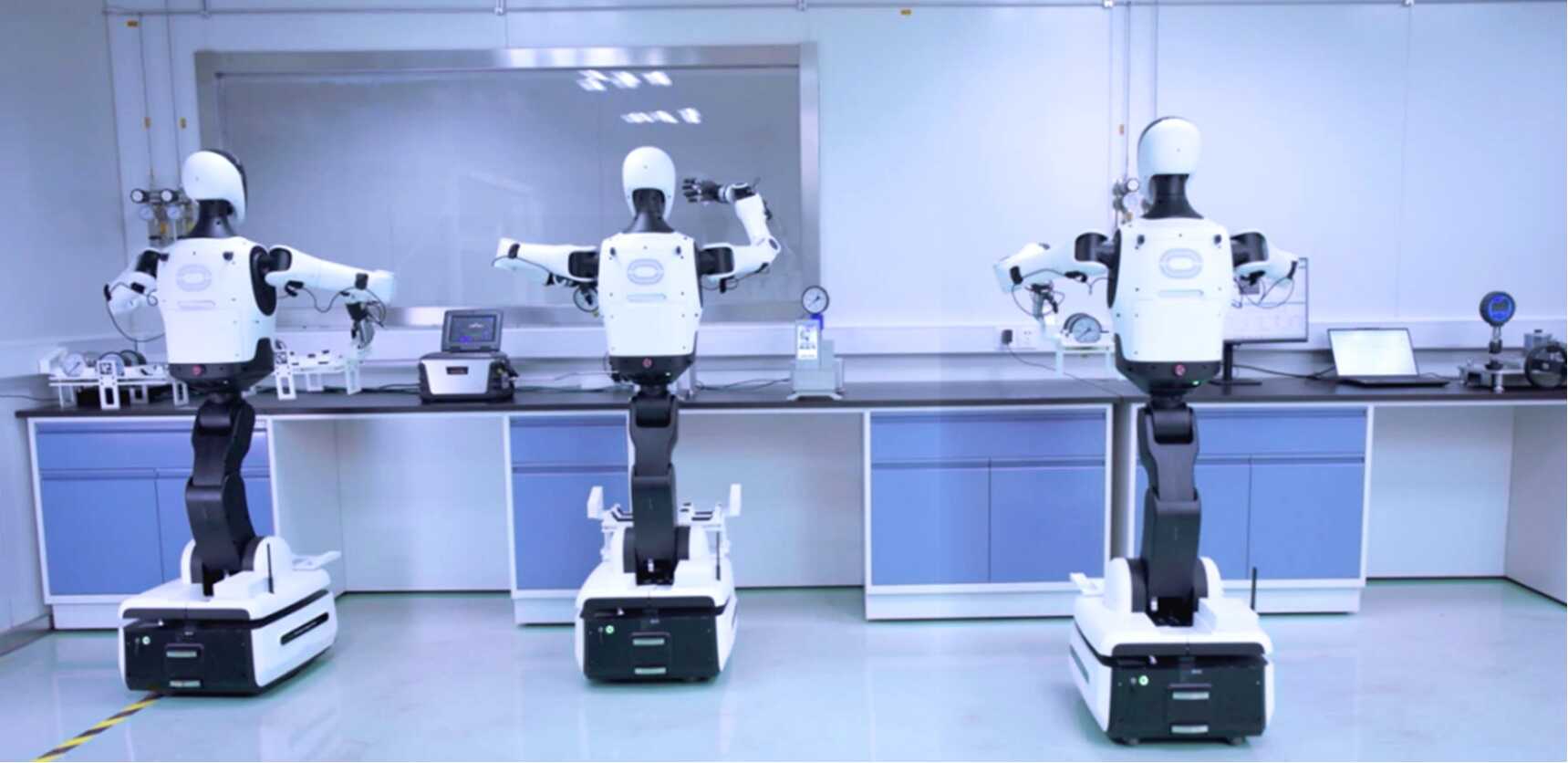
A humanoid robot developed by the Beijing Innovation Center of Humanoid Robotics has been deployed to automate pressure gauge calibration, a process traditionally involving repetitive manual work and potential exposure to industrial hazards. Its new TianYi 2.0 solution can operate around the clock, perform tasks with millimeter-level precision, and complete the full testing process without human intervention.
The solution was unveiled at the 3rd Metrology Instruments and Equipment Exhibition 2026. Developed using the center's Wise Kaiwu platform, which integrates large and small AI models for perception, decision-making, and motion control, it is designed for demanding metrology tasks in environments that are dirty, dangerous or repetitive.
Automating high-risk testing tasks
Pressure gauges are essential safety instruments in industries such as mining, energy, and equipment manufacturing. Their accuracy is directly linked to the safe operation of industrial systems.
Calibration has traditionally required technicians to repeatedly increase and decrease pressure, install and remove gauges, take readings and record results. The process is labor-intensive, and differences in manual readings can affect measurement consistency. It can also expose workers to risks such as fluid leaks and equipment-related impacts.
The TianYi 2.0 solution is designed to take over these high-risk and repetitive tasks. Supported by Wise Kaiwu's perception, decision-making, and motion-control capabilities, the robot can operate under complex conditions in high-pressure testing environments, reducing the need for personnel to perform hazardous manual procedures.
Validated in two real-world testing environments
Unlike prototype systems demonstrated only in controlled settings, the solution has completed validation in two operational environments: the laboratory of Beijing ConST Instruments Technology Inc. and the Jiangsu Institute of Metrology.
TianYi 2.0 can conduct high-throughput calibration continuously, reducing variations caused by operator fatigue and improving the consistency and reproducibility of test results. It also records multimodal testing data throughout the process.
Equipped with a highly articulated, human-like hand and reinforcement learning algorithms, the robot performs precision operations at millimeter-level accuracy. It can independently complete the entire workflow: moving gauges, mounting them on testing equipment, coordinating calibration, removing them and sorting them according to whether they pass or fail inspection.
Another advantage is that the solution does not require users to modify their existing calibration equipment. The robot communicates with current testing systems through compatible interfaces and can accommodate mainstream pressure gauge models on the market. It can also connect to users' systems to automatically register instruments, determine test results and generate reports.
This makes the solution suitable for wider deployment at metrology institutes, corporate measurement and quality-control departments, and third-party calibration providers.
Expanding applications in metrology
Pressure gauge calibration builds on the center's earlier metrology applications, which included solutions for testing infrared thermometers and temperature and humidity meters, also developed using the Wise Kaiwu platform.
The latest release expands its product range from temperature-related instruments to pressure gauges. By applying the adaptability and flexible manipulation capabilities of embodied AI, the center aims to address testing tasks involving multiple instrument types and high precision requirements that conventional automation equipment can find difficult to handle.
A representative of the center said humanoid embodied AI could become a new source of productivity in metrology laboratories. The center plans to work with industry partners to explore further applications of the technology in measurement and testing services.